

$39.99
Research Studies:


FREE Shipping on
orders over $200
ALL ARTICLES AND PRODUCT INFORMATION PROVIDED ON THIS WEBSITE ARE FOR INFORMATIONAL AND EDUCATIONAL PURPOSES ONLY. The products offered on this website are intended solely for research and laboratory use. These products are not intended for human or animal consumption. They are not medicines or drugs and have not been evaluated or approved by the FDA to diagnose, treat, cure, or prevent any disease or medical condition. Any form of bodily introduction is strictly prohibited by law.
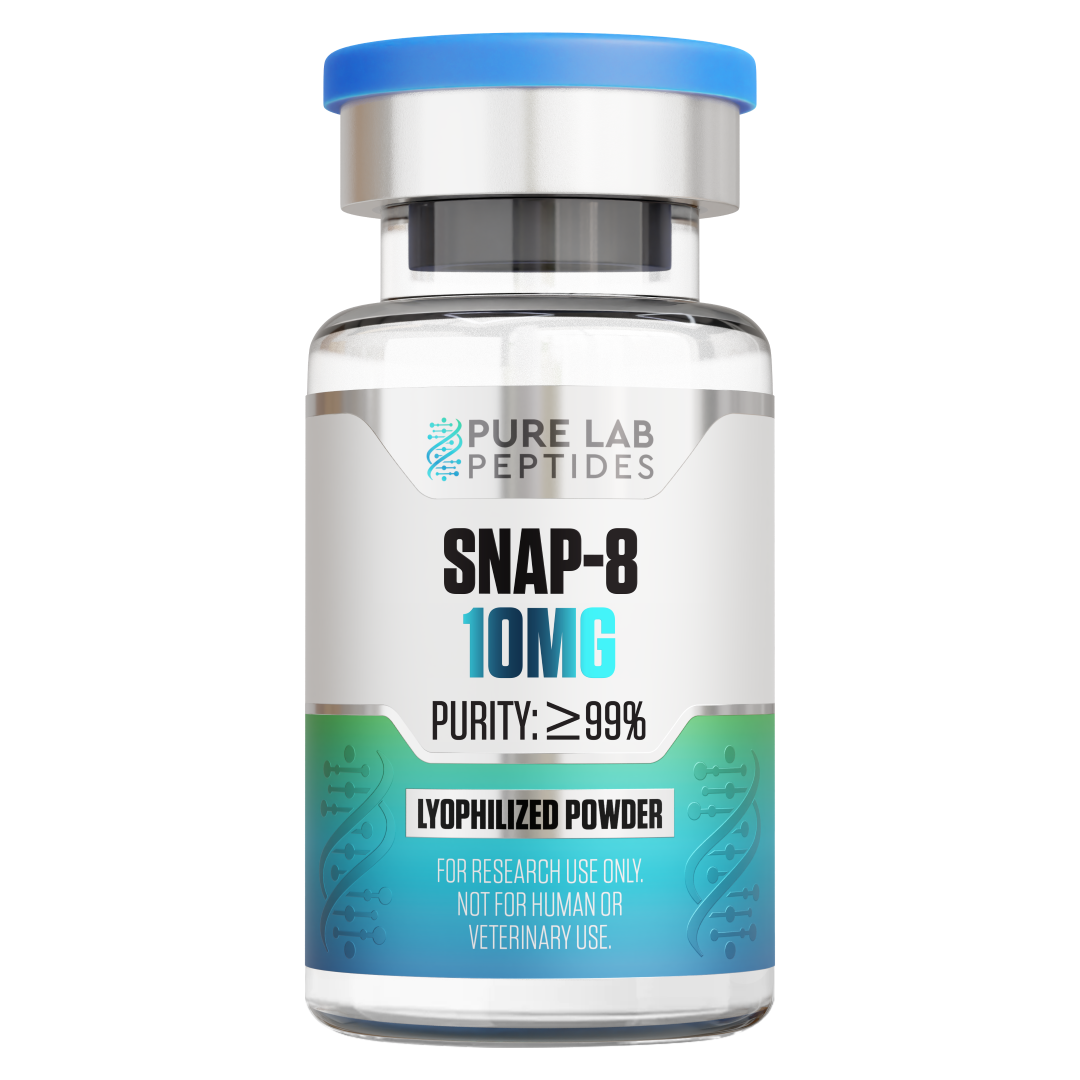
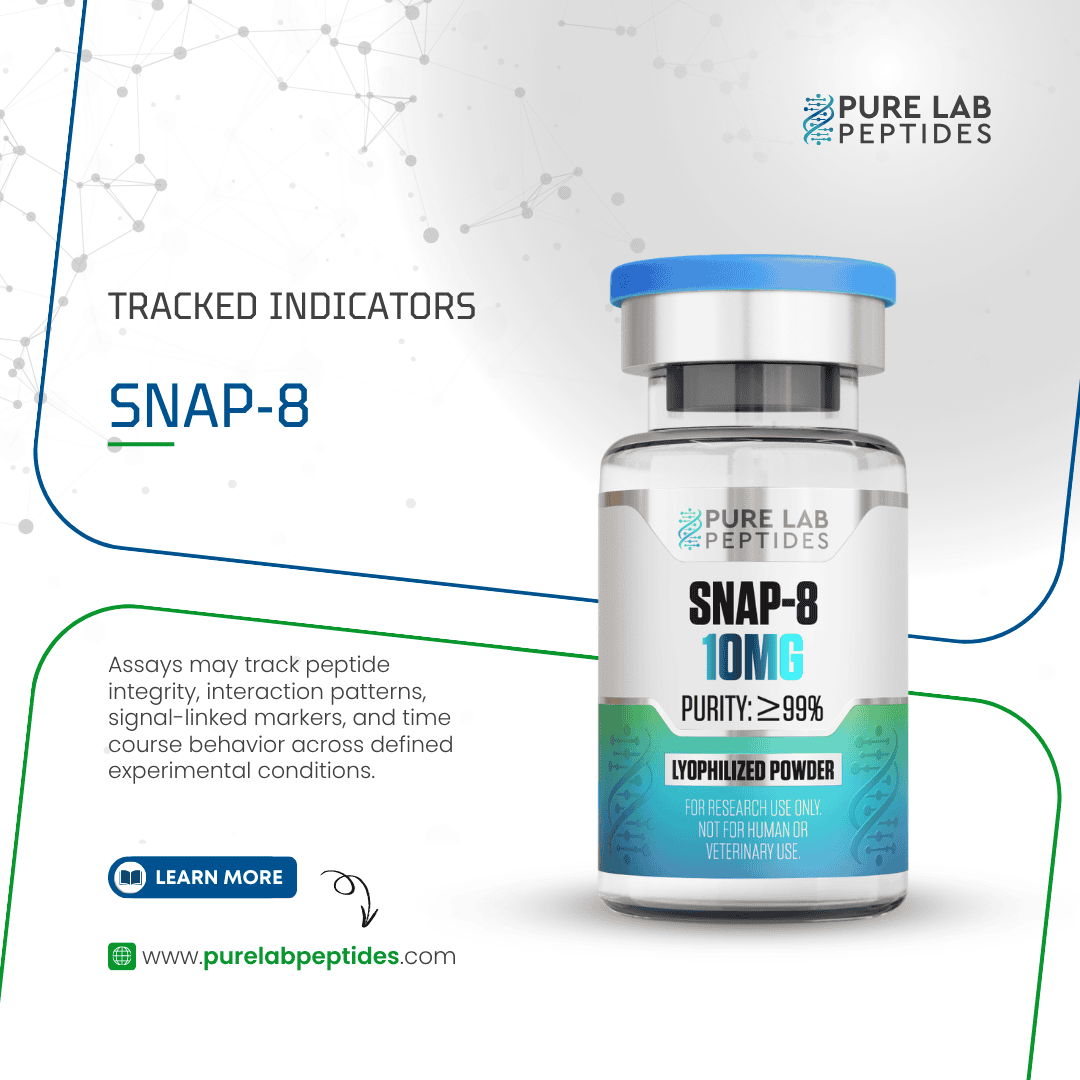
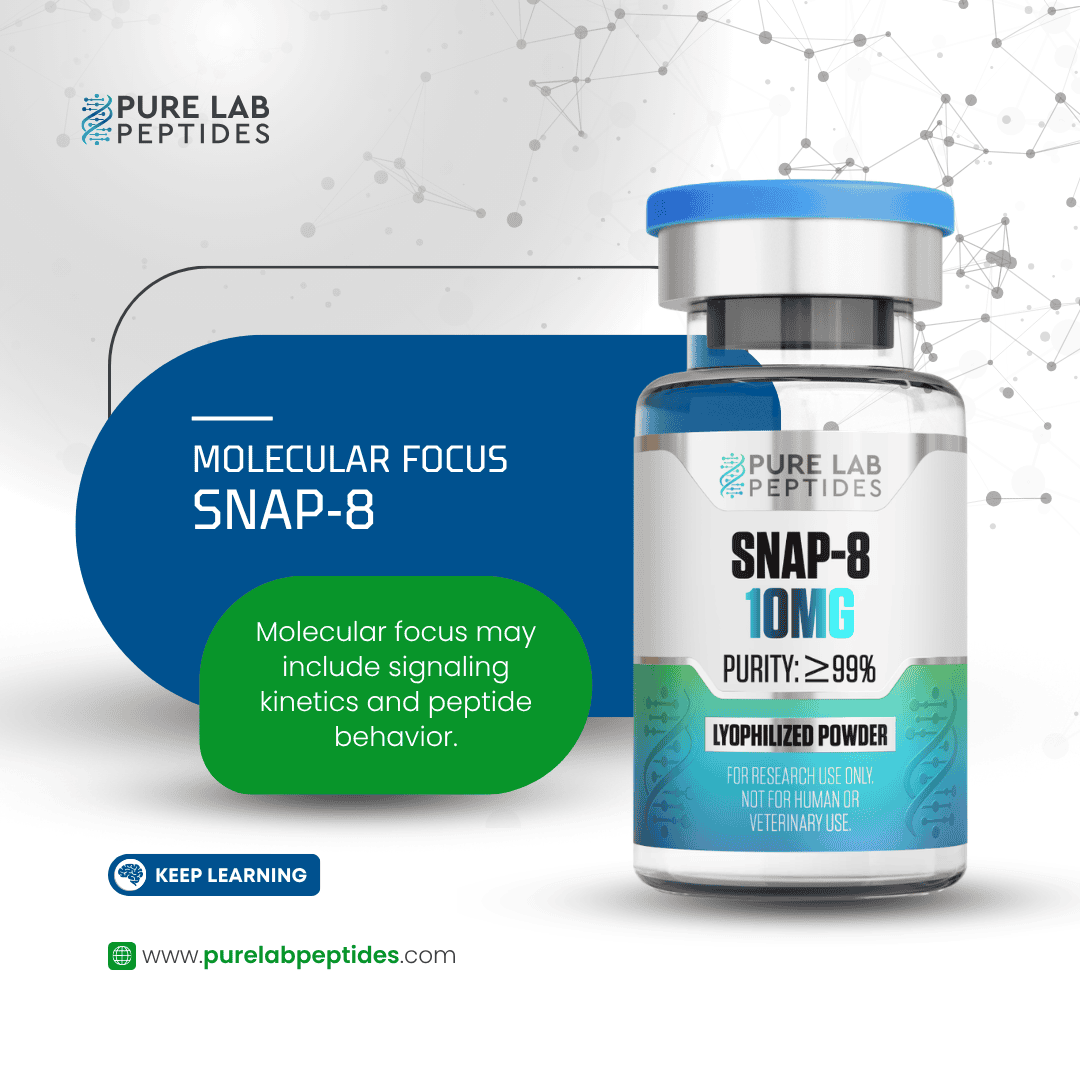
SNAP-8 10mg is a research-use-only laboratory material supplied for controlled research workflows, compound characterization, and analytical documentation review. It is manufactured under rigorous quality standards to support consistency, traceability, and batch-specific verification for qualified laboratory settings.
SNAP-8 10mg is intended strictly for laboratory research use only. This product is not intended for human or animal consumption, therapeutic use, diagnostic use, clinical use, veterinary use, or as a food, drug, cosmetic, dietary supplement, or household product.
| CAS No. | 868844-74-0 |
|---|---|
| Molecular Formula | C41H70N16O16S |
| Molecular Weight | 1075.2 g/mol |
| Purity | ≥99% |
| Sequence | Acetyl-Glu-Glu-Met-Gln-Arg-Arg-Ala-Asp-NH2 |
| Synthesis Method | Solid-phase synthesis |
| Format | Lyophilized powder |
| Solubility | Water/Sterile Diluent |
| Stability & Storage | Up to 24 months at -20°C. Avoid repeated freeze-thaw cycles. |
| Applications | Cosmetic peptide research, neuromodulation studies, anti-aging skincare development |
| Appearance | White to off-white powder |
| Regulatory/Compliance | Not for human consumption. For research use only. |
| Safety Information | MSDS available upon request |
Consider these supplementary peptides for a comprehensive research approach.
Researchers evaluating where to buy SNAP-8 for research should treat SNAP-8 as the canonical research name for acetyl octapeptide-3, a synthetic octapeptide record listed in PubChem and GSRS-linked databases [1][2]. (PubChem) This product-page guide is written for laboratory research procurement, documentation review, and RUO content clarity. The goal is to help research buyers assess identity records, COA support, analytical testing, lot traceability, and claim boundaries without turning literature context into product-use claims.
Researchers looking to buy SNAP-8 for research should first verify the compound name, acetyl octapeptide-3 identity records, batch-specific COA, HPLC purity data, LC-MS or mass spectrometry support, lot traceability, and RUO labeling. Products discussed in this article are intended for laboratory research use only and are not intended for human or animal consumption. Literature context should remain separate from product positioning.
The original commercial query “buy snap-8” becomes safer and more precise when rewritten as buy SNAP-8 for research. That phrase keeps the procurement intent intact while making clear that the page is about laboratory material evaluation, not non-laboratory application.
For Pure Lab Peptides, the commercial value of this page comes from helping qualified research buyers make documentation-first comparisons. The safer keyword does not change the compound target. It changes the frame from consumer buying language to RUO procurement review.
The first documentation layer should be compound identity. Researchers should compare the SNAP-8 name against acetyl octapeptide-3, database identifiers, sequence descriptors, and lot-level documentation before moving deeper into analytical review [1][2]. (PubChem)
The second layer is the batch-specific certificate of analysis. A COA should connect the product listing to a specific lot and should report measurable analytical data rather than broad quality statements.
RUO labeling sets the boundaries for the material and the product page. It signals that the content should focus on compound characterization, research documentation, and laboratory procurement, not non-laboratory claims.
That matters because search data around SNAP-8 often overlaps with consumer-facing phrases. A research product page must prevent those phrases from becoming product positioning.
SNAP-8 is commonly associated with acetyl octapeptide-3, a synthetic octapeptide listed by PubChem with the synonym “Acetyl-glu-glu-met-gln-arg-arg-ala-asp-amide” and a computed molecular weight record of 1073.2 g/mol [1]. (PubChem) FDA-linked substance records also connect acetyl octapeptide-3 with UNII 8K14HJF88S and CAS 868844-74-0 [2]. (NCATS Inxight Drugs)
In a research-material context, those identifiers help technical buyers check whether the product label, COA, supplier record, and literature naming all point to the same compound.
SNAP-8 belongs in a synthetic peptide analog research lane. Its octapeptide naming reflects an eight-residue peptide structure, while the acetylated naming convention helps distinguish the modified compound identity from a generic peptide fragment [1]. (PubChem)
For procurement teams, classification is not just academic. It determines which analytical records should be checked, which literature should be considered relevant, and which search terms should be treated as boundary-sensitive.
“SNAP-8” is a short commercial-style research name. “Acetyl octapeptide-3” is the clearer chemical-entity phrase for documentation, source review, and database matching [1][2]. (PubChem)
Using both names in product-page copy improves clarity. It also reduces ambiguity when researchers compare labels, COAs, third-party test files, and published literature.
Sequence-level documentation helps distinguish the intended compound from related peptide analogs. PubChem’s synonym field records acetyl-glu-glu-met-gln-arg-arg-ala-asp-amide for acetyl octapeptide-3, which gives researchers a useful identity checkpoint [1]. (PubChem)
Sequence details should still be treated as documentation fields, not as product claims. The practical question is whether the label, COA, identity testing, and supplier documentation are internally consistent.
SNAP-8 fits a synthetic peptide analog research category because published peptide literature places acetylated peptide sequences into broader discussions of peptide synthesis, molecular identity, and model-specific pathway investigation [3][8]. (PMC)
This category also explains why analytical testing matters. Synthetic peptides can contain sequence-related impurities, synthesis byproducts, or identity mismatches if characterization is incomplete [12][19]. (PubMed)
Solid-phase peptide synthesis is a foundational method in modern peptide chemistry. A peer-reviewed peptide synthesis overview explains that SPPS anchors a growing peptide chain to an insoluble resin and extends it through stepwise addition cycles [8]. (PMC)
This background is useful for procurement review because synthesis history can affect the kinds of analytical records researchers expect to see. The product page does not need to describe a manufacturing workflow in operational detail, but it should encourage identity and purity verification.
Amino acid sequence data supports compound identification by giving reviewers a structural target to compare against analytical results. Mass spectrometry literature notes that synthetic peptide sequences are often known, so MS methods are commonly used to confirm identity and purity [11]. (PubMed)
For SNAP-8, sequence documentation should be viewed alongside molecular weight, chromatographic data, and batch records. No single field should be treated as the entire quality review.
Molecular weight is a core identity attribute for peptide research materials. PubChem lists a computed molecular weight record for acetyl octapeptide-3, and mass spectrometry methods can help confirm whether observed mass data aligns with the expected compound identity [1][11]. (PubChem)
Researchers should treat molecular weight as a cross-check, not a standalone proof. A stronger review compares molecular weight, sequence descriptor, COA, chromatogram, mass data, and lot number.
Research-use-only positioning keeps the page anchored to laboratory review. In this context, SNAP-8 content should focus on the research material, not on non-laboratory applications.
That positioning supports both compliance and search quality. It helps commercial-intent readers understand what to evaluate before procurement while keeping the article within RUO boundaries.
RUO product-page copy should describe what researchers can verify. It can explain identity documentation, COA availability, purity testing, analytical methods, lot traceability, storage records, and supplier documentation.
It should not convert literature terms into claims about a material’s purpose outside laboratory research. That separation is the main editorial control for a safe product-page guide.
Laboratory research framing gives the article a clear audience: qualified researchers, lab teams, and technical procurement teams. It also reduces ambiguity around the commercial keyword.
This is especially important for SNAP-8 because many public search terms around the compound come from consumer product categories. Pure Lab Peptides should keep the article focused on documentation, not those categories.
A documentation-led listing gives readers verifiable information. The most useful fields are compound name, synonym, lot number, COA, testing method, purity result, identity confirmation, and storage documentation.
This creates practical value without implying a non-laboratory purpose. It also gives procurement teams a repeatable way to compare supplier records.
Published literature has discussed SNAP-8 and related peptide analogs in the context of peptide categories, sequence design, and SNARE-related models [3][4]. (PMC) That literature can help researchers understand how the compound appears in academic and technical discussions.
It should not be interpreted as product-use guidance for an RUO material. The safer interpretation is that literature gives background context, while supplier documentation verifies the material being evaluated.
Peptide analog literature often compares sequence features, molecular targets, and model systems. Reviews discussing SNAP-8 describe it in relation to acetylated peptide analogs and SNARE-associated mechanistic concepts [3][4]. (PMC)
For this page, those discussions belong in the scientific background section only. They do not define the intended purpose of a Pure Lab Peptides RUO compound.
In vitro research can examine model-specific interactions under controlled experimental conditions. It cannot, by itself, justify broad claims about product performance or non-laboratory outcomes.
This distinction matters because SNAP-8 literature may discuss molecular pathways. A safer interpretation is to treat those findings as model-specific research context that requires careful source review.
Translational limits help prevent overreach. Even when a peer-reviewed source discusses a compound class or pathway, that source does not automatically support claims for a supplier’s RUO research material.
Some published literature outside the scope of RUO product use has examined this compound class in human study settings. That literature should not be interpreted as a use claim for research-use-only materials.
The pathway context around SNAP-8 is usually discussed through SNAP-25 and SNARE-related models. SNAP-25 is a component of the SNARE protein complex, which is involved in exocytotic release mechanisms in synaptic and neuroendocrine research models [6][7]. (PMC)
This pathway background is valuable for literature interpretation. It must stay separate from claims about the RUO material.
SNARE and SNAP-25 literature may discuss neurotransmitter-related release models because these proteins are central to vesicle fusion and exocytosis research [6][7]. (PMC) A PubMed-indexed study on SNAP-25-patterned peptides reported inhibition of SNARE complex formation and neuronal exocytosis in experimental models [5]. (PubMed)
That does not create a product claim. It gives researchers a mechanistic literature category to review.
A pathway mention does not prove how a research material performs in a given experimental setting. It also does not establish non-laboratory purpose, suitability, or outcome.
For product-page copy, pathway relevance should be framed as background. The product itself should be evaluated through COA data, identity testing, purity records, and lot documentation.
Mechanistic phrases can easily become product claims if they are separated from study design and model context. SNAP-8 copy should therefore avoid claim-heavy language and stay with neutral verbs such as “examines,” “describes,” “investigates,” and “reports.”
This approach supports both compliance and scientific accuracy. It lets the page acknowledge literature without overstating it.
Evidence interpretation should separate three questions: what the compound is, what literature has examined, and what supplier documentation verifies. The first question is answered through identity records, the second through peer-reviewed literature, and the third through COA and testing records.
That separation is the core information-gain framework for this page.
Researchers should separate literature background from supplier documentation. Literature may describe model-specific findings, while the supplier record should show what material is being supplied and how that batch was tested.
This distinction is also important for quality review. A peer-reviewed discussion of a compound class does not replace a batch-specific COA.
A useful source quality filter starts with official databases, peer-reviewed literature, analytical chemistry references, and recognized standards. PubChem and GSRS-linked records support identity review, while analytical-method literature supports testing interpretation [1][2][11]. (PubChem)
Vendor pages, forums, influencer content, and unsourced marketing claims should not be treated as scientific evidence. They may inform search behavior, but not scientific conclusions.
Study design determines what can and cannot be concluded. A model-specific experiment may help explain a pathway or analytical method, but it does not establish a product-purpose claim for an RUO material.
| Research Area | What Literature Examines | Evidence Type | RUO Interpretation |
|---|---|---|---|
| Compound identity | Names, identifiers, formula records, synonym records, and sequence descriptors for acetyl octapeptide-3 [1][2] | Database, substance record | Useful for label and COA cross-checking, not a product claim |
| Peptide analog context | SNAP-8 discussion within broader peptide analog literature [3][4] | Review literature | Helpful background, not supplier-specific verification |
| SNARE-related models | SNAP-25 and SNARE complex involvement in vesicle fusion research [5][6][7] | Mechanistic and review literature | Pathway context only |
| Analytical testing | HPLC, MS, and LC-MS methods for peptide purity and identity review [10][11][12] | Analytical chemistry literature | Supports documentation review |
| Quality documentation | Validation principles, lab competence, and reference material concepts [14][16][17] | Official standard and official resources | Helps structure procurement review |
Research literature and product claims are different categories. Literature describes what investigators studied under defined conditions. Product claims present what a supplier says about a material.
For RUO product pages, the safer approach is clear: use literature for background and use batch-specific documentation for material review.
Study findings should not be copied into product positioning. A scientific paper may discuss a pathway, model, or compound class, but a supplier page should not present those findings as outcomes for the RUO material.
This rule is especially important for search phrases such as serum, wrinkle, and anti-aging. Those terms can drift into consumer-facing product claims, so they should be handled only as language-boundary examples and kept separate from SNAP-8 research positioning.
Claim boundaries define what the page can safely say. It can say that SNAP-8 is associated with acetyl octapeptide-3 identity records, that published literature discusses SNARE-related models, and that HPLC or LC-MS can support analytical review [1][5][10][11]. (PubChem)
It should not claim non-laboratory outcomes. It should not treat customer reviews as evidence of compound identity, purity, or suitability for laboratory research.
Product documentation keeps the page grounded. It gives the buyer a concrete review path: identity, COA, purity, analytical method, lot number, storage documentation, and RUO label.
That framework also improves SEO quality. It answers commercial research intent with specific, useful information rather than broad marketing language.
A certificate of analysis should function as a batch-specific technical record. For SNAP-8 research materials, the COA should help connect the product label, lot number, testing method, purity data, and identity review.
COA documentation cannot replace independent scientific review. It is one component of a larger procurement decision.
A useful COA should include the compound name, lot number, testing date, lab source, purity result, testing method, and identity-supporting data when available. Analytical validation guidance from ICH explains that analytical procedures may be directed toward identity, purity, impurity, assay, and other qualitative or quantitative measurements [14].
For research procurement, the practical question is whether the COA is specific, dated, method-aware, and matched to the lot being evaluated.
Batch specificity matters because one lot should not be assumed equivalent to another without documentation. Peptide characterization literature has emphasized that incomplete structural characterization can make interpretation difficult [19]. (PMC)
A batch-specific COA gives researchers a record tied to the exact material under review. That is more useful than a generic statement about quality.
Dates and lot numbers support traceability. A COA date shows when the analytical record was generated, while the lot number connects the record to a production batch or supplier file.
Research buyers should compare the lot number across the label, product listing, COA, and any supporting analytical report. A mismatch should trigger further review before procurement.
High-purity language should be tied to data. In peptide review, purity claims are most useful when supported by chromatographic evidence and method details.
Identity review should be treated as a separate but related question. A material can show a strong chromatographic profile while still requiring mass-based confirmation.
HPLC is widely used for peptide analysis and purification, including reversed-phase, ion-exchange, size-exclusion, and other modes described in peptide chromatography literature [10]. (PubMed) For SNAP-8 documentation, HPLC data can help researchers interpret purity reporting when the method and chromatographic record are available.
A purity percentage should not be read in isolation. Chromatogram context, integration method, and batch matching all matter.
Mass spectrometry is well suited to synthetic peptide identity and purity analysis because the expected sequence is often known and can be compared against observed mass data [11]. (PubMed) LC-MS workflows are also discussed in literature on synthetic peptide impurity characterization [12]. (PubMed)
For procurement review, LC-MS can strengthen confidence when it aligns with the compound name, expected molecular weight, and lot-specific COA.
Mass spectrometry adds a mass-based identity layer that HPLC alone does not provide. LC-HRMS literature has been used for qualitative and quantitative identification and characterization of peptide materials and related impurities [13]. (PMC)
This does not make any product claim. It simply explains why mass data is valuable for research documentation.
A strong analytical review workflow connects the product listing to the batch record and the batch record to testing data. Each step should be documentation-focused.
The goal is not to create an experimental procedure. It is to help procurement teams evaluate whether the supplied records are coherent.
A chromatogram can clarify whether the reported purity result is supported by a visible separation profile. HPLC literature describes multiple chromatographic approaches for peptide analysis, which is why method context matters [10]. (PubMed)
A research buyer should ask whether the chromatogram corresponds to the same batch listed on the COA. The chromatogram is most useful when it is linked to the lot number and testing date.
Reference standards support analytical confidence by giving labs characterized materials for comparison. NIST describes Standard Reference Materials as materials with well-characterized composition or properties, and USP describes reference standards as materials used to demonstrate identity, purity, and quality in official testing contexts [17][23]. (NIST)
For RUO procurement, the broader lesson is simple: reliable analytical review depends on traceable, well-documented comparisons.
Assay purity is one data point in supplier evaluation. ICH Q2(R2) frames analytical procedure validation around fitness for intended purpose and includes common uses such as identity, purity, impurity, assay, and other measurements [14].
A documentation-first review should place purity beside identity verification, lot traceability, and label consistency.
Lab-test verification protocol for documentation review
Lot traceability connects a physical research material to its documentation. In a supplier review, that connection should be visible across the label, COA, testing report, and internal procurement record.
Without lot traceability, technical review becomes less reliable. The buyer cannot confidently know which analytical result belongs to which material.
Lot traceability supports accountability and reproducibility. NIST’s metrological traceability resources emphasize the importance of traceability policies and measurement support in technical measurement systems [18]. (NIST)
For SNAP-8, the same principle applies at the documentation level. The research buyer should be able to trace the product listing to a lot-specific analytical record.
Batch records help confirm which material was produced, tested, labeled, and supplied. They also help procurement teams compare one purchase record against another without assuming that all lots are identical.
For research teams, batch accountability protects data interpretation. It gives the lab a record of what was evaluated before the material entered inventory.
Labeling consistency should confirm the same compound name, synonym, lot number, and RUO status across documents. SNAP-8 and acetyl octapeptide-3 should not appear as disconnected identities.
If a supplier record contains inconsistent names, missing lot fields, or unsupported purity statements, the documentation needs additional review.
Pure Lab Peptides product-page documentation should make research procurement easier. It should help buyers find the information that matters most: identity, purity, testing, lot traceability, storage documentation, and RUO labeling.
That approach supports commercial research intent while staying within a documentation-first framework.
Research buyers should compare suppliers by documentation quality, not by broad marketing language. Useful comparison points include COA availability, analytical methods, identity records, batch specificity, testing date, lot matching, and RUO label clarity.
Analytical-method guidance from FDA and ICH emphasizes the need for suitable analytical procedures and validation principles in regulated analytical contexts [14][15]. While RUO procurement is not the same as a regulatory submission, those principles help explain why method transparency matters.
A good product listing should help a lab team quickly answer basic documentation questions. What is the compound? What synonym should be checked? Is there a COA? Is the lot identifiable? Which method supports the purity result?
These details make the page more useful and more trustworthy. They also reduce the need for unsupported assumptions.
Third-party testing can strengthen procurement review when the report is batch-specific and method-transparent. ISO/IEC 17025 is the international standard for testing and calibration laboratories and addresses competence, impartiality, and consistent operation [16]. (ISO)
That does not mean every report automatically has the same evidentiary weight. Research buyers should still review lab identity, date, method, lot number, and data consistency.
Storage and handling documentation should be treated as part of the research record. It helps a lab maintain a consistent file for receipt, inventory, and material accountability.
This section should remain non-instructional. It should document supplier-stated conditions without offering non-laboratory guidance.
Storage documentation should state the supplier’s recommended storage condition, packaging status, lot number, and any stability-related documentation available. Stability and release testing are common categories in analytical quality systems, and ICH Q2(R2) notes that analytical procedures may apply to release and stability testing contexts [14].
For RUO procurement, the buyer’s task is to record supplier documentation accurately in the lab’s internal file.
Handling notes should support laboratory recordkeeping. They should not become practical guidance for non-laboratory application or consumer behavior.
A safer product-page approach is to keep the language limited to documentation, packaging, storage records, and institutional lab procedures.
Packaging records can support chain-of-custody review by helping labs connect receipt condition, label details, lot number, and supplier files. These details are part of material accountability.
A complete procurement file should make it possible to reconstruct which material was ordered, received, tested, stored, and evaluated.
SNAP-8 search intent can be noisy. Some phrases come from literature, some from consumer markets, and some from supplier documentation.
A safe RUO product page should clarify the difference.
Consumer search terms should not steer a research product page. Even when terms appear in keyword tools, they may belong to non-laboratory categories.
This is why Pure Lab Peptides should prioritize research-safe phrasing. The article can address commercial research intent without adopting consumer framing.
Commercial interest often starts with a simple buying query. It becomes risky when the page shifts from procurement documentation into product-performance language.
For SNAP-8, the safer path is to answer what research buyers should check: identity, COA, HPLC, LC-MS, lot number, label, and RUO status.
Research pages should emphasize verifiable records. The most useful elements are compound identity, analytical method, purity reporting, mass-based identity support, batch specificity, and labeling consistency.
Quality and documentation checklist
Before researchers buy SNAP-8 for research, the final review should ask whether the product page and supporting files tell one coherent story. The strongest review is not based on one phrase or one number. It is based on consistent documentation.
For Pure Lab Peptides, that means a product page should guide research buyers toward identity review, COA confirmation, analytical testing, and lot-level traceability.
A SNAP-8 documentation checklist should include the compound name, acetyl octapeptide-3 synonym, lot number, COA, testing date, purity method, identity method, label details, storage documentation, and RUO status.
It should also include a literature-boundary reminder. Published studies may provide scientific context, but they do not define the purpose of an RUO research material.
Lab teams can review supplier fit by comparing whether the supplier makes documentation easy to locate and easy to match to the material. A supplier record is more useful when the COA, testing files, and label information are batch-specific.
The review should also consider whether product-page copy stays within RUO boundaries. Documentation clarity and claim restraint both matter.
The final review should prioritize COA and testing because those records support identity, purity, and batch accountability. HPLC, MS, and LC-MS each add different analytical value when the method is documented and matched to the lot [10][11][12]. (PubMed)
Research-use-only notice: Pure Lab Peptides supplies compounds for laboratory research use only. Products are not intended for human or animal consumption, diagnostic use, therapeutic use, clinical use, veterinary use, or as food, drugs, cosmetics, dietary supplements, or household products. Researchers are responsible for ensuring lawful, appropriate handling and use in accordance with applicable regulations and institutional guidelines.
Next step: Review the product-page documentation, COA details, analytical testing support, lot traceability, and RUO labeling before evaluating SNAP-8 for laboratory research procurement.
Researchers should consider whether the SNAP-8 listing is supported by clear research documentation. Before procurement, review the compound identity, COA availability, batch-specific records, analytical testing, lot traceability, and RUO labeling. The phrase buy SNAP-8 for research should remain tied to laboratory procurement review, not non-laboratory product positioning.
Acetyl group documentation is relevant because SNAP-8 is commonly associated with acetyl octapeptide-3 in compound identity records. For research buyers, this helps connect naming, synonym review, peptide identity, and supplier documentation. The key point is not product performance. It is whether the product label, COA, and batch records consistently describe the same research compound.
Single-peptide means the research material is evaluated as one defined peptide entity rather than as a multi-compound blend. For SNAP-8, that makes identity review more direct because researchers can compare the compound name, synonym, sequence descriptor, purity data, and lot documentation. This term should stay within research documentation context.
“Eight amino acids” may matter because SNAP-8 is discussed as an octapeptide, and octapeptide terminology reflects an eight-residue peptide structure. In a research setting, that detail can support identity review when compared with supplier documentation, sequence descriptors, and analytical records. It should not be treated as a product claim or non-laboratory positioning.
SNAP-8 product pages should stay research-use-only by focusing on compound identity, COA review, analytical testing, lot traceability, and RUO labeling. Boundary-sensitive phrases such as expression lines, fine lines, skincare, and argireline can drift into consumer-facing or product-claim language. They should be kept separate from product positioning and discussed only as language-boundary examples.
There is limited product-style information because SNAP-8 research pages should avoid non-laboratory framing. A compliant RUO page should prioritize research documentation, peptide identity, purity review, supplier records, and published literature boundaries. It should not present consumer outcome language, product-performance claims, or personal-use guidance as part of the product-page content.
The following authors are recognized for published research that helped shape the scientific context discussed in this article.
Author profile: Florida Atlantic University Profile
Gregg B. Fields is recognized for published work relevant to peptide synthesis methodology, peptide characterization, and research documentation. His publications offer useful background for understanding how synthetic peptide analogs are described, prepared for research evaluation, and characterized in laboratory literature. This context supports the SNAP-8 article’s focus on peptide identity, sequence-level documentation, and analytical review within a research-use-only product-page framework.
Selected publications:
Author profile: University of Colorado Anschutz Medical Campus Profile
Robert S. Hodges is recognized for publications relevant to HPLC-based peptide analysis, purification, and analytical method interpretation. His work is especially useful for the documentation-focused portions of this SNAP-8 research page because it supports the article’s discussion of HPLC, peptide purity review, and laboratory evaluation of supplier records. His publications provide technical background for understanding why analytical testing and batch documentation matter in research procurement.
Selected publications:
This research disclaimer clarifies how Pure Lab Peptides frames published literature and search language around SNAP-8. In synthetic peptide analog research content, terms such as snap 8 serum, peptide serum, hyaluronic acid, serum booster, skin care, lines and wrinkles, and serum for face can drift into consumer-facing or product-claim language when framed outside research documentation. Similar phrases, including face serum, formulation, anti-wrinkle, matrixyl 3000, and firming serum, should be treated as boundary-sensitive wording rather than SNAP-8 product positioning.
On this page, those phrases are handled only as research-language examples, not outcomes, recommendations, personal-use guidance, or clinical-use positioning. The focus remains on SNAP-8 identity, COA review, analytical testing, peptide purity, lot traceability, RUO labeling, product documentation, and published literature boundaries. Terms such as topical, facial muscles, botox, dropper, cosmetic active, glycerin, deep wrinkles, face cream, and face and body require the same careful separation from product claims so the page stays centered on research procurement and model-specific literature interpretation.
Our team is ready to assist you with any inquiries regarding our catalogue of peptides and their applications.
Discount Applied Successfully!
Your savings have been added to the cart.
Pure Lab Peptides
You must be at least 21 years of age to enter this site. By entering, you confirm that you are of legal age and agree to our terms.
For research use only.



There are no reviews yet.