

Researchers evaluating where to buy Crystagen for research should begin with documentation, not claim language. This Pure Lab Peptides product-page guide frames Crystagen as a research-use-only peptide material for laboratory review, COA evaluation, analytical testing, and literature interpretation. The article focuses on peptide identity, thymic research context, lot-level records, and RUO boundaries rather than consumer-facing or clinical-use positioning.
Researchers who want to buy Crystagen for research should review RUO labeling, peptide identity, COA availability, lot number alignment, analytical testing, supplier documentation, and literature context before selecting any laboratory research material. Products discussed in this article are intended for laboratory research use only and are not intended for human or animal consumption. Scientific literature should guide research context, not product claims.
The phrase “buy Crystagen” becomes RUO-safe only when the research purpose is clear. For a product page, the safer framing is buy Crystagen for research, because it shifts the question toward laboratory documentation, peptide COA review, and research procurement controls.
A research buyer should not evaluate the page as a wellness article, medical guide, or product-use guide. The page should answer documentation questions: What is the compound name? What does the batch-specific certificate of analysis show? Do the label, COA, and lot information match?
Crystagen research review should start with identity documentation. The core record set includes the product listing, RUO label, batch-specific COA, lot number, analytical testing summary, and storage documentation.
Scientific identity matters because peptide terminology depends on amino acid sequence and peptide bonds. A peptide is generally defined as a short chain of amino acids joined by covalent peptide bonds [6].
RUO labeling helps keep the research material separate from diagnostic, clinical, therapeutic, veterinary, cosmetic, or consumer contexts. FDA guidance for IVD materials explains RUO labeling as a designation for products in a laboratory research phase rather than diagnostic positioning [11].
For Pure Lab Peptides product pages, that boundary supports a narrow purpose: laboratory research review. It does not turn published literature into instructions, product effects, or product-performance language.
A product-page RUO guide should serve technical procurement teams and qualified researchers. The page should make it easy to locate compound identity information, COA details, testing context, and lot-level documentation.
For Crystagen, the priority is not promotional language. The priority is a clean research record that supports peptide research materials used in controlled laboratory settings.
Pure Lab Peptides should frame Crystagen as a research peptide listing. That means the product page can describe the compound name, peptide category, catalog detail, documentation status, and laboratory research use.
The page should avoid turning a compound overview into claims. A strong listing helps researchers compare product documentation without implying that the material has consumer, clinical, or product-use purposes.
Research buyers should confirm that the supplier documentation is batch-specific. A COA without lot alignment gives less value than a COA that clearly maps to the specific research material under review.
The supplier record should also identify the testing method. If a COA lists HPLC purity, LC-MS identity, high-resolution mass spectrometry, or another method, the page should present those records as documentation tools rather than claims about the material’s application.
Crystagen is discussed in the peptide bioregulator lane as EDP, a short peptide sequence described as Glu-Asp-Pro in thymus polypeptide research [1]. The same literature lane also discusses thymalin, KE, EW, and thymogen-related peptides, but same-lane references should be used for context only.
The term “bioregulator” should be handled carefully. In this product-page context, it should describe the research category and literature history, not imply a product effect.
Crystagen peptide identity begins with sequence language. The EDP designation corresponds to glutamic acid, aspartic acid, and proline in the source literature that identifies short peptides in thymalin-related research [1].
Because sequence and identity are different documentation tasks, a product page should not rely on name alone. Identity review should compare the listed peptide name, sequence, analytical method, and lot-level record.
Short peptide documentation is sequence-sensitive. Even when two peptides contain the same amino acids, sequence order can affect identity, which is why primary structure matters in peptide and protein chemistry [7].
For Crystagen, the research documentation should clearly state the amino acid sequence as part of peptide identity review. It should also keep molecular identity separate from research interpretation.
Crystagen belongs in a thymic peptide research context because EDP has been discussed as part of thymalin-related literature [1] [2]. Thymic research context can include thymus, spleen, thymocyte, thymic epithelial cell, immune cell, cytokine, and gene expression models.
That context should remain academic. A product page can summarize what literature examines without presenting the research peptide as a material for human or animal consumption.
Thymic peptide literature often discusses short peptides in relation to cell differentiation, proliferation, apoptosis, and gene expression models [4] [5]. These topics help define the research lane for Crystagen, thymogen, and other thymic peptide references.
The safer interpretation is model-specific. A research page should not imply that a material supplied for laboratory research has the same context, quality system, or intended purpose as compounds discussed in broader literature.
A 2014 Advances in Gerontology article reported that short peptides including vilon, thymogen, crystagen, and R-1 were examined in spleen-related research models [3]. The same abstract specifically notes that crystagen was associated with B-cell immunity-system measurements in that research setting [3].
For product-page copy, this means thymus and spleen references belong in literature interpretation. They should not be written as product-positioning claims.
Cell model language should be precise and limited. Thymic epithelial cells are part of the thymic microenvironment that supports thymocyte development and maturation [8].
That fact helps explain why thymic epithelial cell models appear in same-lane literature. It does not create a claim about a Crystagen product page or any specific research material.
A Crystagen product page can discuss peptide identity through the sequence Glu-Asp-Pro when supported by documentation. It can also describe the compound as a synthesized peptide or synthetic peptide if the supplier documentation supports that classification.
Synthetic identity should be reviewed through records. Peptide synthesis commonly uses solid-phase methods for laboratory preparation of peptides, but every batch still requires documentation and analytical confirmation [17].
The proline, glutamic acid, and aspartic acid sequence clarifies the EDP identity discussed in thymalin-related literature [1]. It gives researchers a concrete peptide sequence to compare across the product listing, COA, and analytical records.
That comparison matters because a peptide name alone can be less precise than the stated amino acid sequence. Sequence-aware documentation supports clearer research procurement.
Peptide bonds link amino acids into a peptide chain [6]. In identity review, the sequence and peptide-bonded chain are part of what distinguishes one research peptide from another.
A COA should not be treated as complete simply because it lists a purity percentage. For peptide identity, analytical records should also support that the detected material aligns with the expected peptide.
The Crystagen literature lane is closely associated with Khavinson, Linkova, Chalisova, Trofimova, and related peptide bioregulator research groups. Their publications discuss short peptides, thymic research models, gene expression, protein synthesis, and cell differentiation across different experimental systems [3] [4] [5] [10].
A product page should cite this background carefully. It should not imply that Pure Lab Peptides products are equivalent to materials used in any specific published study.
Published literature frames peptide bioregulators as short peptide compounds studied in model systems involving cell differentiation and gene expression [5]. Some reviews discuss the ability of short peptides to affect gene expression and protein synthesis in research models [10].
That language belongs in a research context. It does not support consumer outcomes or product-use instructions.
Khavinson peptide references help map Crystagen to the broader short peptide and thymalin-related literature. For example, a 2021 article describes active thymalin components as including dipeptides and a tripeptide, Glu-Asp-Pro, associated with regulation of gene expression, protein synthesis, differentiation, proliferation, and apoptosis in immune-cell research contexts [2].
This is evidence context, not product positioning. RUO copy should keep the citation tied to the literature, not the product.
A safer evidence landscape separates what literature examines from what an RUO product page can say.
| Research Area | What Literature Examines | Evidence Type | RUO Interpretation |
|---|---|---|---|
| EDP identification | UPLC-MS identification of KE and EDP as minor components in thymalin-related research [1] | Analytical and literature context | Supports sequence-aware research framing, not product claims |
| Spleen model research | Short peptides including crystagen and thymogen in spleen-related models [3] | Published experimental literature | Useful for research context only |
| Thymocyte models | Peptidergic regulation of thymocyte differentiation and related endpoints [4] | Preclinical and cellular literature | Helps define the thymic research lane |
| Gene expression | Short peptide literature discussing gene expression and protein synthesis [10] | Mechanistic literature | Requires careful model-specific interpretation |
| Documentation review | Analytical procedures can be validated for identity, purity, assay, and other measurements [12] | Official analytical guidance | Supports documentation standards, not product application claims |

Signal pathway and gene expression language should be limited to what literature can support. In the Crystagen lane, source material discusses short peptides, cellular differentiation models, protein synthesis, cytokine context, and gene expression [2] [5] [10].
The key research boundary is simple. Pathway relevance can explain why a topic appears in academic literature, but it should not become a statement about product effects.
Cell signaling models clarify how researchers organize mechanistic questions. They can connect gene expression, transcription factor activity, cytokine context, and cellular model design.
They cannot, by themselves, show that a research material has any consumer-facing purpose. For product-page writing, signal language should remain tied to models, assays, and literature.
Cytokine language should be interpreted as model-specific. Macrophage literature describes cytokines such as TNF, IL-1, and IL-6 as molecules secreted in response to inflammatory stimuli [9].
Gene expression literature should be treated the same way. If a study examines gene expression or protein synthesis, the product page should state that the literature examined those endpoints, not that the product produces an outcome.
Crystagen and thymogen can appear together because published short peptide literature discusses both in thymic and spleen-related contexts [3]. Thymogen is also mentioned in thymalin-related discussions of short peptide components and same-lane research [2].
Same-lane does not mean interchangeable. Each peptide should be described by its own identity, sequence, documentation, and literature context.
A same-lane comparison should compare documentation categories, not product outcomes. Useful categories include peptide sequence, published research context, analytical method, COA availability, and lot traceability.
This gives research buyers a practical review framework without ranking compounds for consumer purposes.
Thymic epithelial cell models support topic relevance because TECs help form the thymic microenvironment involved in thymocyte development [8]. This makes TEC literature relevant to thymic peptide research discussions.
A product page should still avoid overextending that relevance. The model explains why the topic belongs in the article; it does not create a product claim.
Safe research applications include compound characterization, peptide identity review, analytical method comparison, literature mapping, in vitro model context, and supplier documentation review.
The article should avoid shifting into consumer language. Phrases related to product effects require careful framing because they can become product claims when separated from model-specific literature context.

Published literature and product-page language have different roles. Literature can describe what researchers investigated, but an RUO product page should describe what documentation is available and how the compound fits a research context.
Some published literature outside the scope of RUO product use has examined this compound class in human study settings. That literature should not be interpreted as a use claim for research-use-only materials.
Study findings should stay separate from product claims because variables differ across study materials, models, analytical methods, institutions, and documentation systems. A research peptide product page cannot assume equivalence to published study materials unless the documentation establishes the relationship.
A safer page focuses on COA review, analytical testing, lot alignment, RUO labeling, and research documentation.
Claim boundaries protect the product page from drifting into clinical-use language, Food and Drug Administration positioning, or consumer-facing statements. FDA guidance shows that RUO labeling is tied to intended research context and should not be contradicted by other representations [11].
For Crystagen, the boundary is practical: keep the discussion about peptide identity, literature context, analytical records, and procurement review.

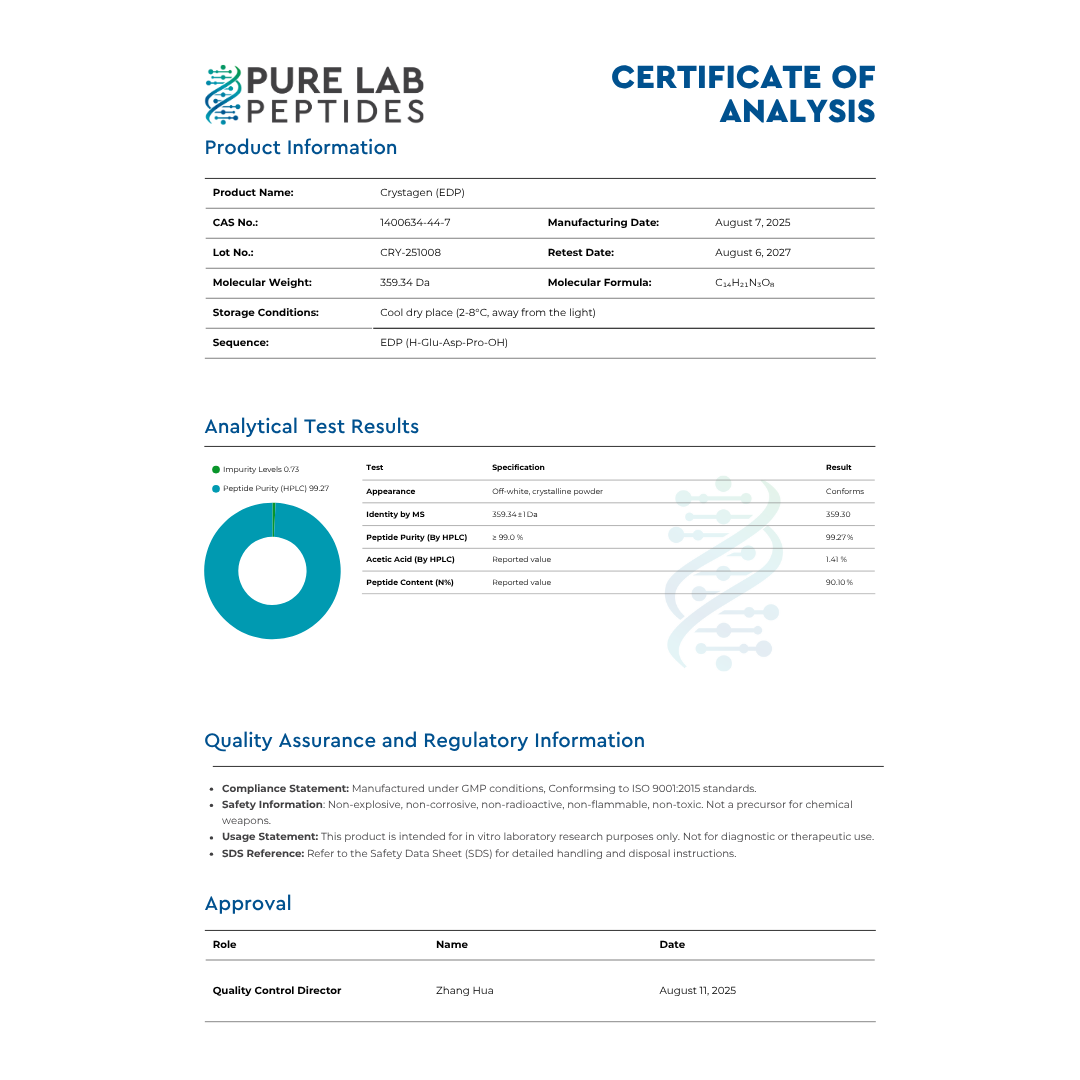
COA documentation matters because it is the bridge between a product listing and a batch-specific research material. A COA can summarize identity, purity, lot number, method, and date when those elements are included.
Analytical validation guidance treats identity, purity, assay, and quantitative or qualitative measurements as common uses of analytical procedures [12]. That makes COA review central to research procurement.
A batch-specific certificate of analysis should show the compound name, lot number, test date, testing method, purity result, identity method, and document source. If HPLC or LC-MS is listed, the COA should identify the role of each method.
For peptide review, the best question is not whether a number looks high. It is whether the batch-specific certificate of analysis supports the peptide identity and matches the product label.
COA dates and lot numbers help research teams trace the document back to the listed material. A mismatch between label, product page, and COA should be resolved before a procurement decision.
Label alignment also reduces ambiguity. The peptide name, sequence, catalog detail, and supplier documentation should tell the same story.
Lab teams should compare the product listing, COA, label, lot number, analytical methods, and storage notes. When a method is included, the team should also review whether it supports purity, identity, or both.
This documentation matrix supports reproducibility in laboratory research. It also keeps procurement decisions centered on records rather than marketing language.

Analytical testing helps confirm whether the material described in the product documentation matches the expected peptide identity. HPLC is widely used for peptide separation and purification analysis, and mass spectrometry supports molecular identification by measuring ion signals such as mass-to-charge values [14] [15].
A workflow is strongest when methods are complementary. Purity review and identity verification answer related but distinct questions.
HPLC supports peptide purity review by separating components in a sample and generating chromatographic information that can be evaluated by retention behavior and detector response [14]. For peptide COA review, HPLC data are useful when the method and batch relationship are clear.
HPLC purity alone should not be treated as complete identity confirmation. It is one part of analytical documentation.
LC-MS supports identity verification by coupling liquid chromatography separation with mass spectrometry detection [15]. In peptide research, mass data can help compare observed signals with expected peptide identity.
LC-MS is especially useful when paired with a documented sequence, lot-specific COA, and clear analytical record. The product page should not overstate what a single method can prove.
High-resolution mass spectrometry can add specificity to peptide identity review when the analytical method is appropriate. Literature on peptide identification and LC-MS/MS shows how mass spectrometry data support peptide and protein identification workflows [15].
For Crystagen, this means mass data should be treated as technical documentation. It should not be presented as a product-performance claim.
Mass-to-charge data help laboratories compare observed ion signals against expected values in a mass spectrometry workflow [15]. That comparison can support identity review when the method, calibration, and reporting are clear.
For a product page, the point is documentation clarity. A mass value should be tied to the COA and lot record rather than displayed without context.
Reference standards can help anchor analytical review when the laboratory method uses them appropriately. FDA method-validation guidance emphasizes that analytical procedures should be suitable for their intended purpose and documented with appropriate validation elements [13].
A product page does not need to overdescribe the laboratory method. It should make clear what documentation exists and how researchers can review it.
Testing records support research procurement by reducing uncertainty around identity, purity, and lot traceability. A documentation-focused lab-test verification protocol can look like this:
Storage and handling documentation should be presented as laboratory record information. It should not become operational guidance for personal or consumer purposes.
A comparative study of peptide storage conditions found that temperature and storage environment can affect peptide stability over time [16]. For product-page copy, storage notes should point researchers back to the label, COA, and institutional procedures.
Lyophilized peptide documentation matters because freeze drying is commonly used to support peptide stability during storage and transport discussions. A product page can identify lyophilized form when it is part of the listing or documentation.
The page should also avoid implying universal stability. Storage records may mention conditions such as 4°C or colder laboratory storage, but the research team should rely on the product label, COA notes, and internal laboratory records.
Storage notes should be descriptive, not instructional. Safe language includes “review storage documentation,” “record label conditions,” and “compare supplier notes with laboratory requirements.”
This keeps the page focused on documentation. It avoids turning product information into practical personal-use guidance.

Research procurement should be systematic. For lab peptides, the core question is whether the supplier documentation supports identity, purity, lot traceability, and RUO clarity.
A practical Crystagen review can follow this checklist:
Before they buy Crystagen for research, researchers should review the product listing, COA, lot number, peptide identity, analytical testing, storage documentation, and RUO language. The product page should make each of those checkpoints easy to find.
A strong review also checks for common misunderstandings:
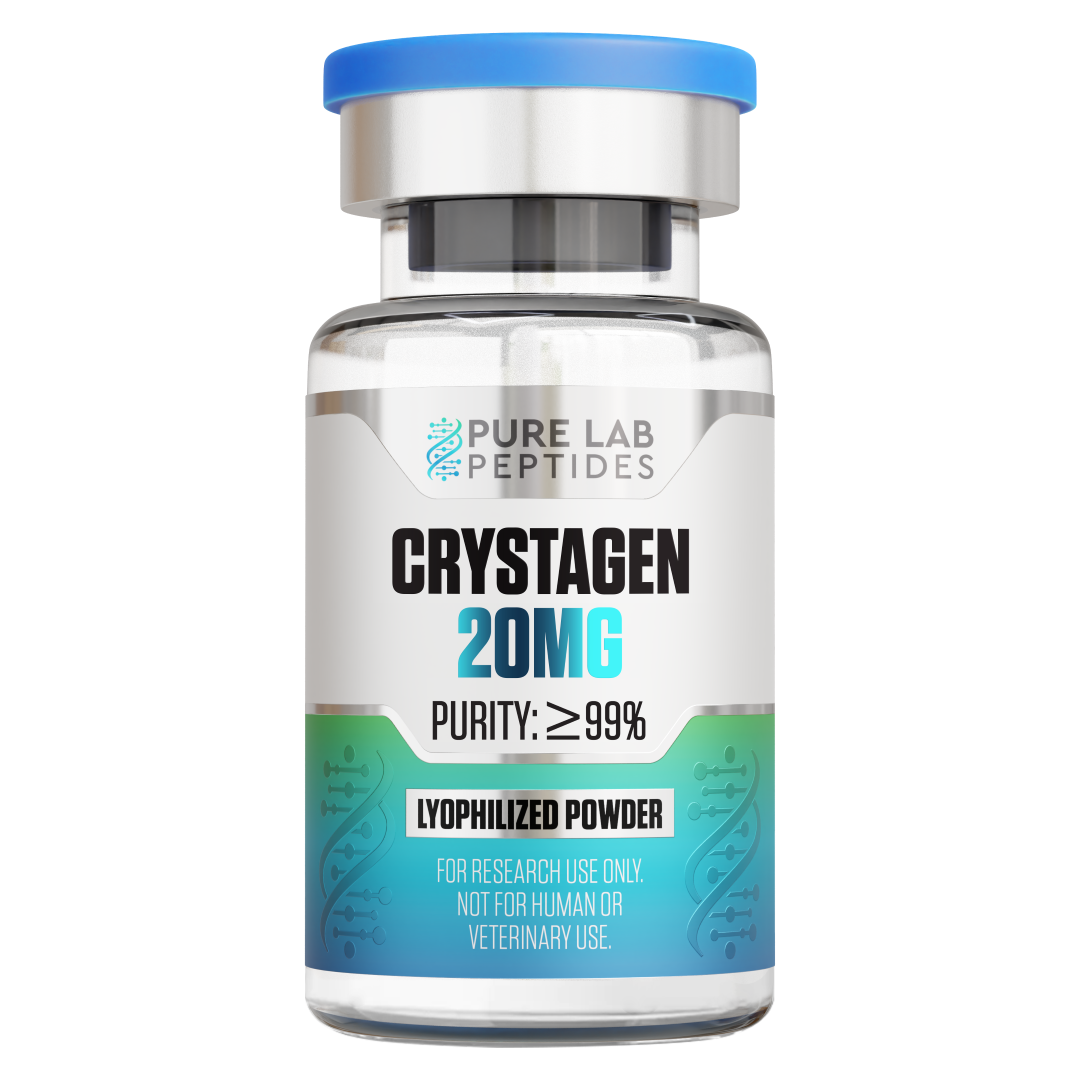
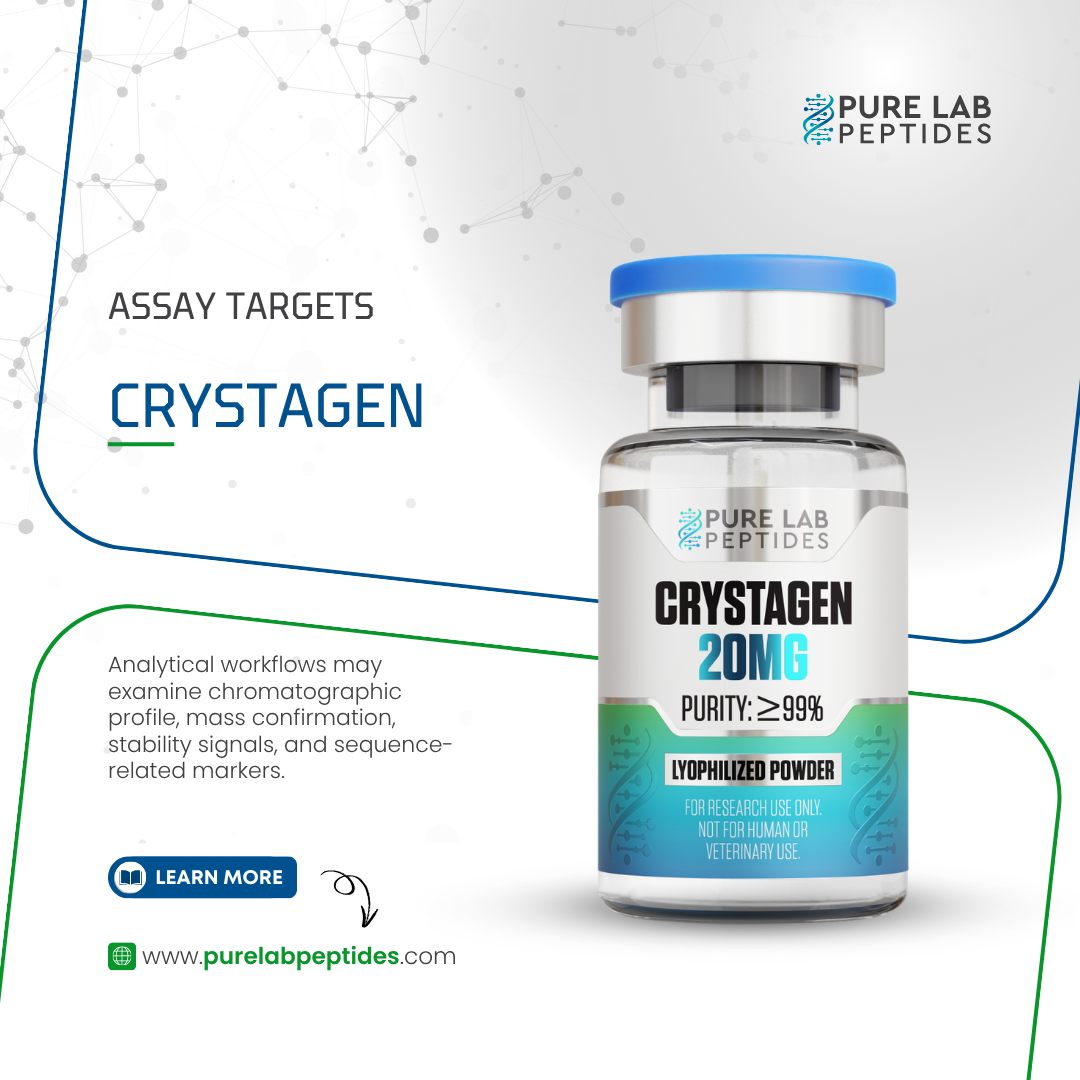
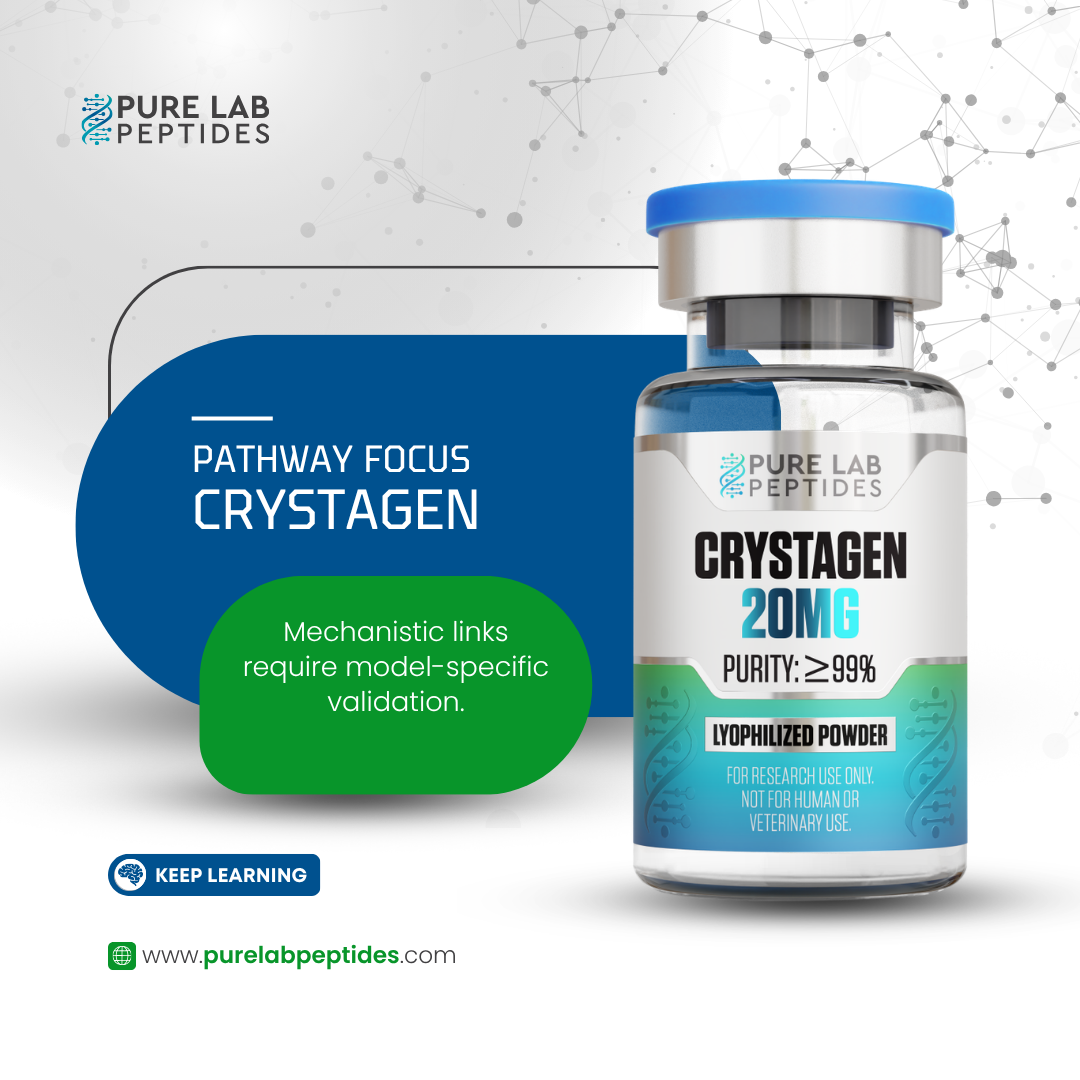
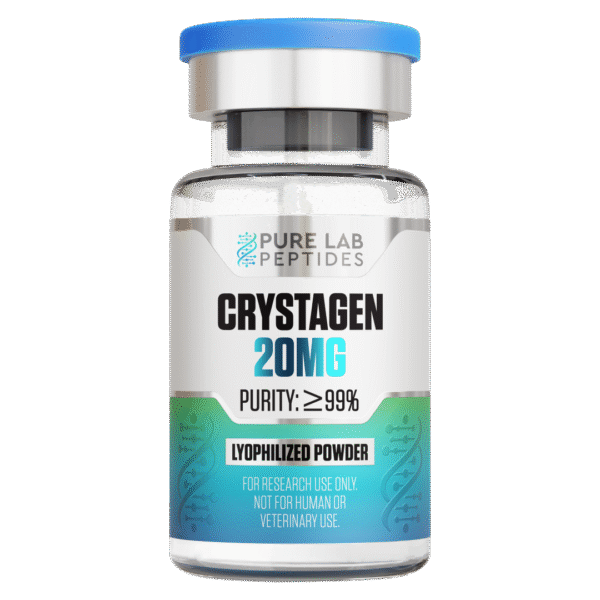
The 20mg amount should remain a catalog listing detail. It should not be treated as a recommendation, experimental design instruction, or product-use direction.
This distinction protects the canonical product page from variant-specific SEO targeting. The target compound remains Crystagen, not a strength-specific page.
Documentation review supports next-step evaluation by giving research teams a clean basis for comparing peptide research materials. The record set should include RUO labeling, COA availability, analytical testing, lot traceability, supplier documentation, and storage notes.
Pure Lab Peptides supplies compounds for laboratory research use only. Products are not intended for human or animal consumption, diagnostic use, therapeutic use, clinical use, veterinary use, or as food, drugs, cosmetics, dietary supplements, or household products. Researchers are responsible for ensuring lawful, appropriate handling and use in accordance with applicable regulations and institutional guidelines.
Review the product-page documentation, COA details, analytical testing context, and RUO labeling before evaluating this compound for laboratory research.
Research use only means Crystagen is intended solely for qualified laboratory research contexts. For product-page review, that means researchers should focus on product documentation, RUO labeling, COA records, peptide identity, and supplier documentation rather than consumer-facing interpretations. The material is not positioned for human or animal consumption.
Researchers should consider documentation first before they buy Crystagen for research. The key review points include RUO labeling, batch-specific COA records, lot traceability, peptide identity, and analytical testing. Research buyers may also compare whether the product listing describes Crystagen as a laboratory material for research purposes rather than as a consumer-facing product.
A COA matters for Crystagen research materials because it connects the product listing to batch-specific documentation. Researchers can review whether the compound name, lot number, purity information, and identity records align across supplier documentation. A COA is most useful when it supports documentation consistency rather than broad claims about research compounds.
Published literature about Crystagen should be interpreted as research context, not product-positioning language. Literature can help researchers understand how a peptide complex, chemical compound, or same-lane short peptide is discussed in model-specific studies. Those findings should remain separate from product claims and should be connected back to documentation, COA review, and RUO labeling.
Crystagen identity means the product documentation should clearly describe the peptide being reviewed. In the cited literature, Crystagen is a synthetic tripeptide associated with the EDP sequence, which contains amino acids described as glutamic acid, aspartic acid, and proline [1]. Researchers may compare identity records, sequence information, and documentation consistency across the product listing and COA.
Batch-specific documentation for Crystagen should show the compound name, lot number, COA details, analytical testing method, and label alignment. When available, molecular weight information can also support peptide identity review if it is verified through appropriate documentation. The goal is to create a clear laboratory record for research purposes without extending into product-use claims.
The following authors are recognized for published research that helped shape the scientific context discussed in this article.
Author profile: RUDN Journal Profile
Vladimir Khavinson is recognized for published short-peptide research that appears throughout the literature context behind this Crystagen page. His work is especially relevant to the discussion of EDP, peptide bioregulator research, thymic peptide literature, and sequence-aware interpretation. The publications highlighted here help ground the article’s focus on compound identity, short-peptide research models, and careful separation between published literature and RUO product-page positioning. His work also provides useful background for understanding how Crystagen can be discussed as part of a broader bioregulator peptide research lane.
Selected publications:
Author profile: Loop Profile
Natalia Sergeevna Linkova is recognized for published work connected to short-peptide literature, thymic research models, and cell differentiation research. Her publications are relevant to the article’s discussion of thymic peptide context, peptide bioregulator framing, and model-specific literature interpretation. The selected publications help support a research-focused view of Crystagen’s broader category without turning study language into product claims. Her work also provides useful background for discussing how peptide identity, research model context, and literature boundaries can be handled on an RUO product page.
Selected publications:
This research disclaimer clarifies how this page handles published literature and search language around Crystagen. In Bioregulator Peptide Research content, phrases such as immune system function, immune function, immune decline, promoting immune, potential of Crystagen, and biologically active can drift into consumer-facing or wellness language when separated from model-specific research context. Related terms such as immune response, age-related, clinical outcomes, and product performance also require careful framing so they remain literature-context examples rather than product-positioning statements.
Here, boundary-sensitive phrases are handled only as research-language examples, not outcomes, instructions, recommendations, or product claims. Terms such as absorption, bioavailability, wellness language, and administration-focused language should remain separate from Crystagen product documentation unless they are being discussed as boundary categories. The focus remains on Crystagen identity, COA review, analytical testing, peptide purity, lot traceability, RUO labeling, product documentation, and published literature boundaries.
Discount Applied Successfully!
Your savings have been added to the cart.




There are no reviews yet.