

This product-page guide explains how research buyers can buy Ipamorelin for research through a documentation-first lens. Ipamorelin is a synthetic pentapeptide cataloged in public chemical databases and described in peer-reviewed literature as a selective growth hormone secretagogue research compound [1] [2] [3]. The focus here is research-use-only product evaluation: compound identity, COA review, analytical testing, lot traceability, supplier documentation, and careful separation of published literature from product claims.
Research buyers should check RUO labeling, batch-specific COA availability, peptide identity data, purity testing, LC-MS or comparable identity verification, lot matching, supplier documentation, and storage records before they buy Ipamorelin for research. Products discussed in this article are intended for laboratory research use only and are not intended for human or animal consumption. Scientific literature should be read as model-specific context, not product positioning.
The phrase “buy Ipamorelin for research” carries commercial intent, but the safe product-page answer is not a buying shortcut. It is a procurement review process.
For research teams, the commercial question becomes: does the listing provide enough documentation to evaluate the compound as a laboratory material? That means a clear research-use-only label, a compound name that matches the COA, and a lot number that connects the physical material to its analytical file.

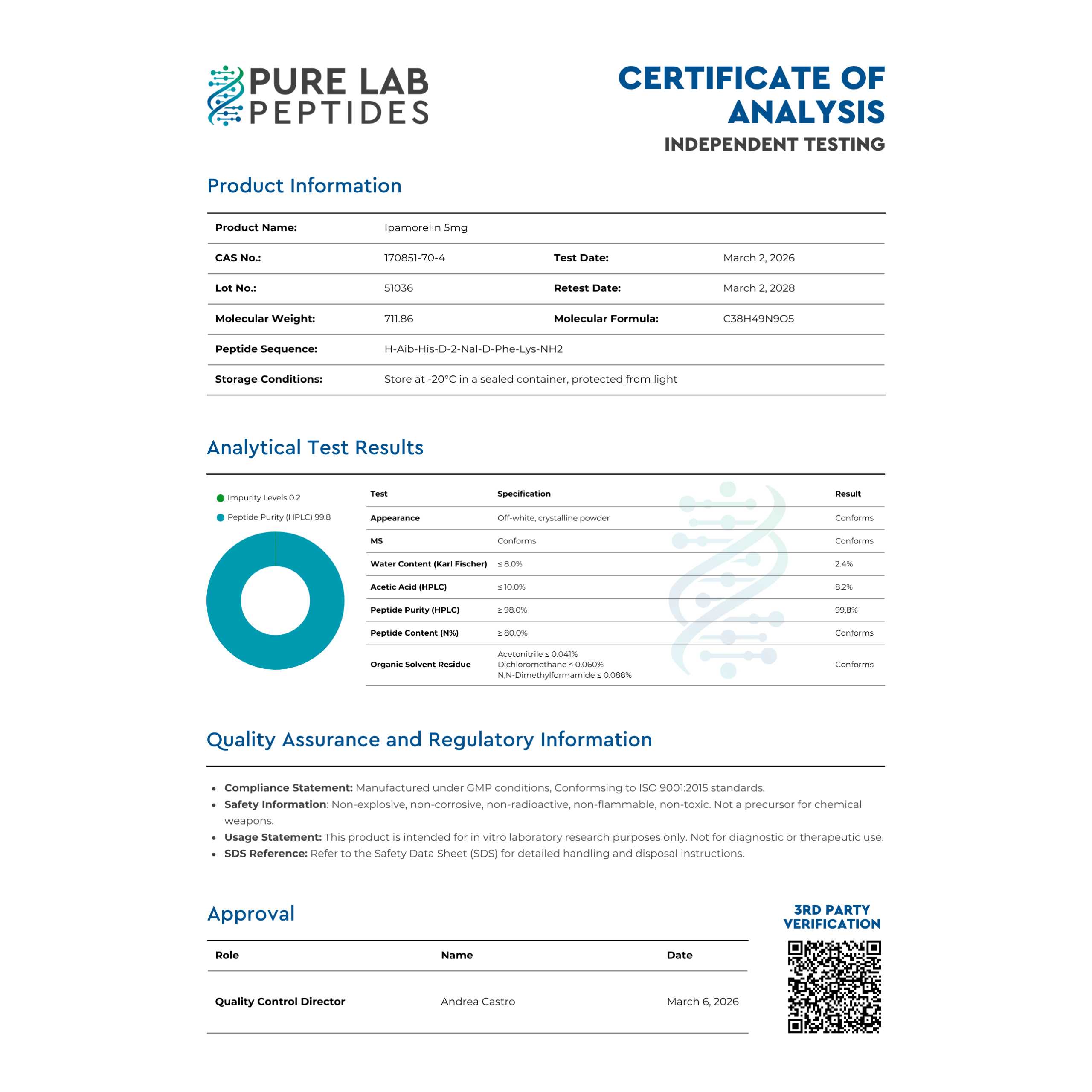
Start with the product label, certificate of analysis, and batch-specific testing records. A COA should identify the compound, lot, test date, assay method, and purity or identity result in a way that can be matched to the research material.
Analytical guidance from ICH and FDA describes validation concepts for procedures used to evaluate identity, purity, assay, and related measurements [19] [20]. Those official frameworks are not a substitute for supplier-specific files, but they explain why method clarity matters.
RUO labeling sets the boundaries for how the page, product records, and supporting literature should be interpreted. FDA’s RUO guidance for IVD products illustrates the core distinction between laboratory research labeling and diagnostic positioning, while 21 CFR 809.10 includes the familiar research-only labeling concept in the IVD setting [27] [28].
For this product-page article, RUO means the language stays focused on laboratory research, documentation review, and analytical verification. It does not turn academic pathway discussion into a claim about a Pure Lab Peptides product.
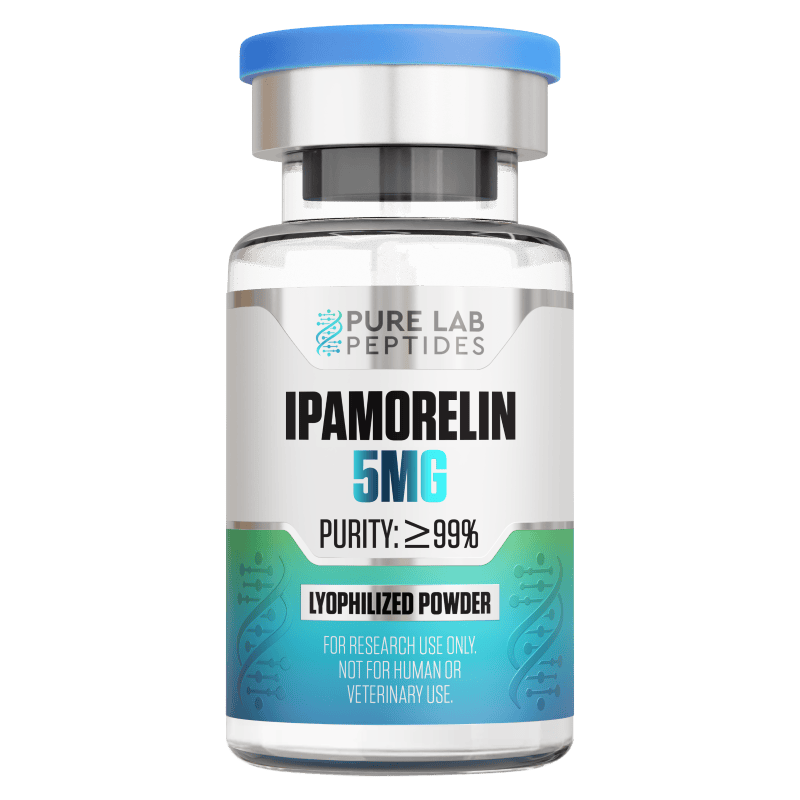
Ipamorelin appears in chemical and bioactivity databases as a peptide compound with the molecular formula C38H49N9O5 and an approximate molecular weight of 711.9 g/mol [1] [2]. Peer-reviewed literature describes Ipamorelin as a pentapeptide with the sequence Aib-His-D-2-Nal-D-Phe-Lys-NH2 [3].
That identity information is useful for product-page review because it gives laboratory buyers a baseline for checking supplier documentation. If the product label, COA, database identity, and analytical records do not align, the listing needs closer review.
Ipamorelin is a synthetic peptide classified in the growth hormone secretagogue research lane [3]. In the literature, its relevance comes from receptor-pathway research, not from product claims.
That distinction matters. A compound can be discussed in peer-reviewed studies while an RUO product page still remains limited to research documentation, compound characterization, and supplier evaluation.
A pentapeptide contains five amino-acid residues. For Ipamorelin, sequence-level identity helps researchers compare product documentation against published compound descriptions and database records [1] [3].
Sequence, molecular weight, and molecular formula should not be treated as marketing copy. They are technical reference points for label review, COA comparison, and identity verification.
The growth hormone secretagogue receptor, also known as GHSR or the ghrelin receptor, was identified as a receptor involved in endocrine signaling research [4]. Ghrelin was later described as an endogenous acylated peptide ligand for that receptor pathway [5].
Ipamorelin literature fits into that broader GHSR research context. The safe interpretation is pathway context: receptor literature helps explain why the compound appears in endocrine pathway research, not what a product does.
Ipamorelin research peptide evaluation starts with identity. The key question is whether the material being reviewed matches the documented compound.
Public records can support this review. PubChem provides chemical identity data, ChEMBL provides bioactivity-oriented compound information, and peer-reviewed literature provides sequence and receptor-class context [1] [2] [3].
A practical documentation review compares three layers: formula, molecular weight, and sequence. Ipamorelin’s database formula and mass should be checked against the COA and the supplier’s listing [1] [2].
Sequence confirmation is more demanding than reading a purity percentage. Peptide analysis often requires complementary methods, because chromatographic purity and molecular identity answer related but different questions [21] [22].
Researchers should verify that receptor language is framed as literature context. GHSR is a G-protein-coupled receptor, and official gene and protein databases describe it as a ghrelin receptor involved in receptor signaling [9] [10].
A product page should not overstate receptor binding as a product claim. The safe framing is that published sources discuss ligand-receptor models, while procurement review focuses on documentation.
A product-page article can address commercial research intent without becoming a personal buying guide. The keyword should be answered through RUO procurement criteria.
For Pure Lab Peptides, that means the article should help laboratory buyers understand what to review before selecting a research material: COA availability, purity testing, identity verification, lot traceability, and label consistency.
Research use messaging prevents the page from drifting into non-RUO positioning. The first promise of a research product page should not be an outcome; it should be documentation clarity.
This approach also serves SEO safely. It captures commercial research intent while keeping the page aligned with laboratory research, supplier evaluation, and analytical review.
Product listings should avoid turning scientific mechanisms into claims. For example, receptor pathway literature may describe GH-related signaling models, but a product page should not translate that into product effects or product performance language.
A safer structure is simple: identify the compound, summarize the literature lane, describe documentation, explain COA review, and keep all model findings separate from product positioning.

GH secretagogue and GHRH research overlaps around endocrine pathway models, but the receptor systems are different. GHSR literature centers on ghrelin-receptor signaling, while GHRH research centers on the growth hormone-releasing hormone receptor.
This difference is important for same-lane context. Ipamorelin and CJC-1295 may appear together in search behavior, but they should still be evaluated as distinct research entities unless a product listing and documentation clearly define a specific material.
Ghrelin receptor research includes receptor discovery, endogenous ligand identification, and intracellular signaling models [4] [5] [6]. Reviews describe GHSR signaling as a complex receptor system with ligand-regulated and constitutive activity considerations [6] [7].
For Ipamorelin, this literature gives the article its research lane. It does not provide claims about any RUO product.
Pituitary cell literature appears often in this research area because GHRH and GHSR pathways are studied in endocrine signaling models. GHRHR is described by NCBI Gene as a receptor for growth hormone-releasing hormone, and UniProt describes the receptor as coupled to G proteins that activate adenylyl cyclase [11] [12].
That is scientific context, not page-level product positioning. Product copy should state what documentation is available, not imply laboratory findings are transferable to non-research settings.
GHRH signal models center on GHRHR and cAMP-related signaling in pituitary cell systems [13] [14]. GHSR signal models center on ghrelin receptor activation, receptor conformation, and intracellular signaling pathways [6] [8].
This is why CJC-1295 and Ipamorelin research should not be collapsed into one generic peptide topic. They can belong to the same research lane while still requiring separate identity and documentation review.
Ipamorelin research is most safely discussed through receptor and signaling pathways. This includes GHSR, ghrelin receptor context, selectivity, and model-specific GH pathway literature.
The page should not present pathway relevance as a product claim. Pathway relevance means the compound appears in a research model; it does not define a use case for a research material.
Selectivity means a compound is described in literature as having a more focused receptor or pathway profile than comparator compounds under study conditions. The original Ipamorelin literature characterized it as selective in GH secretagogue research and discussed pituitary hormone markers such as prolactin in the context of selectivity evaluation [3].
That does not mean the product page should make endpoint claims. It means the literature can be summarized as receptor-pathway context.
Signal transduction is the chain of molecular events that follows ligand-receptor interaction. Reviews of GHSR describe intracellular signaling, receptor regulation, and ligand-dependent activity as areas of ongoing research [6] [7].
In an RUO product page, those concepts support topical relevance. They should be connected back to published literature, not used as claims about a product listing.
GH pathway findings should be described as model-specific research observations. The safest article pattern is: “published literature examined,” “researchers characterized,” or “models described.”
A product page should not say that a research material produces a biological outcome. It should say that GH secretagogue literature provides a pathway context for reviewing Ipamorelin as a laboratory research compound.
CJC-1295 and Ipamorelin often appear in the same search environment because both relate to GH secretagogue and GHRH research. That does not mean the article should create blend claims or variant-specific SEO targeting.
Same-lane context is useful when it clarifies different mechanisms. It is unsafe when it implies combined product positioning without product-specific documentation and appropriate research framing.
CJC-1295 is discussed in the literature as a GHRH analog, while Ipamorelin is discussed as a GH secretagogue research peptide associated with GHSR literature [3] [15]. The receptor context differs: GHRH analog research points toward GHRHR, while Ipamorelin research points toward GHSR [9] [11].
That difference should be preserved in product-page copy. Same category does not mean same identity.
Pairing language requires caution because search behavior can mix separate compounds, blend listings, and competitor-derived phrases. Published CJC-1295 literature can support background on GHRH analog research, but it does not automatically support claims about CJC-1295 and Ipamorelin materials together [15] [18].
A safe product-page approach is to identify each compound, describe its literature lane, and avoid extrapolating beyond the documented material.
Blend mentions can create confusion if the page starts targeting amounts, formats, or catalog variants instead of the canonical compound. PubChem maintains separate entries for CJC-1295 and CJC1295 without DAC, which shows why exact compound naming matters in documentation review [16] [17].
For this page, Ipamorelin remains the canonical target compound. Catalog specifications should remain secondary to identity, COA, and lot documentation.
Research buyers should read literature by evidence type. A database entry, receptor study, preclinical model, and analytical chemistry paper all answer different questions.
| Research Area | What Literature Examines | Evidence Type | RUO Interpretation |
|---|---|---|---|
| Compound identity | Formula, molecular weight, synonyms, and database identity for Ipamorelin [1] [2] | Official database | Supports documentation comparison, not product claims |
| Ipamorelin classification | Pentapeptide sequence and selective GH secretagogue characterization [3] | Peer-reviewed pharmacology | Supports research-lane context |
| GHSR pathway | Ghrelin receptor discovery and receptor signaling literature [4] [5] [6] | Mechanistic and review literature | Explains receptor context without non-RUO positioning |
| GHRH same-lane context | CJC-1295 as a GHRH analog in published research [15] [18] | Academic literature | Clarifies adjacent pathway context |
| Analytical verification | HPLC, LC-MS, and peptide impurity characterization [21] [22] [23] | Analytical chemistry | Supports COA and batch-file review |
Study design matters because a receptor model, database entry, and analytical method paper do not carry the same meaning. A receptor study can explain pathway context, while a COA and analytical file help evaluate a specific batch.
Research buyers should not flatten all evidence into one “proof” category. A safer evidence ladder is: database identity, peer-reviewed pathway context, model-specific findings, analytical documentation, and supplier-specific batch records.
Research models are limited by their design, conditions, and scope. Some published literature outside the scope of RUO product use has examined this compound class in human study settings. That literature should not be interpreted as a use claim for research-use-only materials.
Product-page language should return to documentation. The product listing can identify a research material, but it should not convert literature findings into clinical-use language.

The key research boundary is simple: published literature is not product copy. Literature helps explain why a compound is relevant to a research lane; documentation shows what a supplier is providing.
This section is not the final Language Boundaries section. It is a claim-boundary framework for keeping the article focused on RUO product evaluation.
Claim boundaries protect the page from turning mechanisms into marketing. A receptor pathway sentence should remain tied to the cited study or database, while supplier claims should stay tied to COA, label, and batch documentation.
This is especially important in GH secretagogue and GHRH research because endocrine pathway language can easily drift into non-research interpretations.
Product-page copy should keep literature context separate from product positioning. It should also keep pricing and availability language secondary to identity and documentation.
A safe page can say that researchers may review Ipamorelin as a research peptide within GH secretagogue literature. It should not state that the product creates outcomes outside laboratory research.
Literature context is not product-claim evidence because published studies evaluate specific compounds, models, and methods under defined research conditions. A supplier listing is a separate artifact that needs its own COA and lot-level documentation.
That is the central RUO rule for this article. Scientific context explains the research lane; supplier documentation supports procurement review.

A certificate of analysis is one of the most important records on a research product page. It should help connect the listed compound to a batch-specific analytical result.
A strong COA review does not stop at a purity number. It asks whether the compound name, lot number, testing method, date, and lab source align with the product documentation.
A COA should clarify compound identity, lot number, testing date, assay method, and reported analytical findings. ICH Q2(R2) explains that analytical procedures may be used for identity, purity, impurity, assay, and related measurements, which is why the method field matters [19].
For peptide materials, COA interpretation should be conservative. The COA should support documentation review, not replace independent technical judgment.
Lot traceability connects a specific research material to a specific analytical record. If the product label and COA do not share a matching lot number, the documentation chain is incomplete.
Test date also matters. It helps the laboratory buyer determine when the analytical record was generated and whether it reasonably supports the listed material.
Researchers can compare COA consistency by reviewing the same fields across supplier files: compound name, lot number, test method, purity result, identity method, lab source, and date.
Reference-standard literature also shows why well-characterized standards and coordinated analytical approaches matter for peptide quality evaluation [24]. The product-page takeaway is practical: documentation should be specific enough to review.

Purity and identity are related, but not identical. HPLC can help review chromatographic purity, while LC-MS can help evaluate molecular identity and related impurity characterization [21] [22] [23].
The strongest documentation set often combines method disclosure, chromatographic data, identity-oriented mass data, and batch matching. A single percentage without method context is less informative.
HPLC separates mixture components and produces chromatographic peaks that can be interpreted in relation to retention time, peak area, and separation quality [21] [25]. For peptide work, reversed-phase and other HPLC modes have long been used in analysis and purification contexts [21].
For product-page review, HPLC supports purity assessment. It does not, by itself, prove full identity.
LC-MS combines chromatographic separation with mass spectrometry. Mass spectrometry measures ion signals by mass-to-charge ratio, which can support molecular identity review when paired with appropriate method data and reference expectations [22] [26].
For synthetic peptides, LC-MS workflows can also help characterize impurities and confirm molecular features relevant to batch documentation [22] [23]. That makes LC-MS especially useful when the product page claims identity support.
Analytical verification should be treated as a documentation workflow. The goal is not to provide laboratory handling instructions; the goal is to show what records should be reviewed before procurement.
This workflow is documentation-focused and RUO-safe. It does not describe product preparation or non-research application.
Mass spectrometry data can support technical review by comparing observed mass-related signals to expected compound identity. NCBI’s mass spectrometry overview explains that MS outputs mass-to-charge information, while LC-MS peptide literature describes its role in synthetic peptide characterization [22] [26].
For Ipamorelin documentation, the key is whether the supplier file shows enough identity-oriented data to support the product listing.
Third-party testing can add separation between the supplier’s commercial listing and the analytical record. It does not remove the need to review the method, lot match, and reporting details.
A third-party file is most useful when it identifies the compound, names the method, lists the lot, and provides interpretable data. Without those elements, the claim of outside testing is less useful.
Traceability is the record chain that connects a product listing to a batch and a batch to analytical documentation. For research buyers, this chain is often the most practical way to compare suppliers.
The documentation matrix should include product label, COA, test method, lot number, date, storage note, and supplier contact record. Each field helps confirm that the material being reviewed is the same material described in the supporting files.
Storage documentation should be recorded as a laboratory handling requirement, not as a claim about product performance. The product label and supplier documentation should use consistent compound naming and lot identification.
Labeling consistency also supports internal laboratory records. If the label, COA, and listing use different names or unclear synonyms, the discrepancy should be resolved before procurement.
Price language is secondary because an inexpensive listing is not useful without identity and batch records. For research procurement, documentation quality should come before cost comparison.
This is how Pure Lab Peptides can serve commercial research intent safely: research buyers can evaluate the product page, but the decision framework stays grounded in COA review, identity verification, and RUO labeling.
Before selecting any research-use-only peptide, procurement teams should complete a documentation checklist.
This checklist keeps buy Ipamorelin for research intent aligned with technical procurement instead of non-research claims.
Research buyers should compare supplier files for consistency, specificity, and traceability. The best files tell one coherent story: same compound, same lot, clear method, current record, and RUO label.
For peptide materials, analytical completeness matters. HPLC and LC-MS documentation are complementary because one supports purity review while the other supports identity-oriented review [21] [22].
The next step is to review the product-page documentation, COA details, and RUO labeling before evaluating Ipamorelin for laboratory research. If documents are missing, unclear, or not batch-specific, the listing deserves additional review.
Pure Lab Peptides product-page content should keep this review process visible. Research buyers should be able to understand what is listed, what is documented, and where the research boundary begins.
Several common misunderstandings can pull a research page away from RUO positioning. Addressing them early helps keep the product page focused.
First, published literature does not equal product-use guidance. Second, pathway relevance does not equal a product claim. Third, a purity percentage does not prove complete compound identity. Fourth, catalog specifications are listing details, not research conclusions. Fifth, RUO labeling does not support non-research positioning.
Pure Lab Peptides supplies compounds for laboratory research use only. Products are not intended for human or animal consumption, diagnostic use, therapeutic use, clinical use, veterinary use, or as food, drugs, cosmetics, dietary supplements, or household products. Researchers are responsible for ensuring lawful, appropriate handling and use in accordance with applicable regulations and institutional guidelines.
Review the product-page documentation, COA details, and RUO labeling before evaluating this compound for laboratory research.
Researchers should consider documentation quality before they buy Ipamorelin for research. A research-use-only review should prioritize compound identity, COA consistency, lot traceability, analytical testing, and supplier documentation. The product page should support laboratory evaluation, not non-research positioning or outcome-focused language.
The pituitary gland appears in Ipamorelin research context because GH secretagogue literature often examines endocrine pathway models. For RUO product pages, that context should stay tied to published literature and receptor pathway research. It should not be converted into a product claim or a non-research interpretation.
Growth hormone secretagogues fit into this research category as compounds studied in relation to GH secretagogue receptor pathways and endocrine signaling models. Ipamorelin is discussed in this lane alongside related research terms such as receptor agonist, molecular binding, and binding site. Product-page copy should keep that language informational and documentation-focused.
Ipamorelin, GHRP-2, and GHRP-6 are discussed as same-lane research compounds, but they should not be treated as interchangeable. Researchers should compare each compound by identity, receptor literature, analytical documentation, and supplier records. Differences belong in research interpretation, not product-use claims.
In vitro research can show how a compound is examined under controlled laboratory model conditions. For Ipamorelin, those findings should be interpreted as research context only. They do not replace COA review, analytical testing, peptide identity verification, or batch-specific documentation for a research-use-only material.
Ipamorelin literature language should be separated from product claims by keeping study findings, research purposes, and experimental models tied to their original context. A product page should focus on RUO labeling, COA review, lot traceability, peptide identity, and supplier documentation rather than translating literature into non-research positioning.
The following authors are recognized for published research that helped shape the scientific context discussed in this article.
Author profile: KAKEN Researcher Profile
Masayasu Kojima’s published ghrelin research is relevant to the pathway-focused background discussed in this article. His publications provide context for ghrelin, the growth hormone secretagogue receptor, and endocrine signaling models that help frame Ipamorelin within the broader GH secretagogue research lane. That literature is useful for understanding receptor pathway research, while the product-page article remains focused on research-use-only documentation, compound identity, analytical review, and careful literature interpretation.
Selected publications:
Author profile: Google Scholar
Michael T. Boyne II’s published analytical chemistry work is relevant to the article’s documentation-focused sections on LC-MS, mass spectrometry, peptide identity, and quality control. His publications help contextualize method-centered review of complex peptide and protein materials, including analytical testing, batch records, and verification and validation. This contribution is most useful for understanding how orthogonal methods and system suitability concepts support research material documentation without turning analytical literature into product claims.
Selected publications:
This research disclaimer clarifies how this page handles published literature and search language around Ipamorelin. In GH Secretagogue and GHRH Research content, phrases such as Ipamorelin for sale, buy CJC-1295, Ipamorelin blend, 10mg, body composition, peptide therapy, growth hormone levels, efficacy of Ipamorelin, synergistic effect, performance, and recovery can drift into consumer-facing, administration-focused, clinical-use, wellness, or product-claim language when framed incorrectly.
Here, those phrases are handled only as research-language examples, not product uses, outcomes, instructions, or recommendations. The page’s focus remains on Ipamorelin identity, COA review, analytical testing, peptide purity, lot traceability, research-use-only labeling, product documentation, and published literature boundaries. Scientific discussion should stay connected to model-specific research context, while product-page evaluation should stay centered on compound identity, supplier documentation, batch records, and analytical review.
Discount Applied Successfully!
Your savings have been added to the cart.




There are no reviews yet.