

Researchers evaluating where to buy CJC-1295 DAC for research should begin with compound identity, batch-specific documentation, and RUO labeling rather than consumer-facing claims. CJC-1295 is listed in PubChem as a chemical compound record under CID 91971820, with a molecular formula of C165H269N47O46, giving research teams a database point of comparison for identity documentation [1]. This Pure Lab Peptides guide explains how to review CJC-1295 DAC peptide documentation, published literature, analytical testing, and procurement records in a research-use-only context.
Researchers looking to buy CJC-1295 DAC for research should first review RUO labeling, the batch-specific COA, peptide identity data, purity testing, lot traceability, and supplier documentation. Products discussed in this article are intended for laboratory research use only and are not intended for human or animal consumption. Published CJC-1295 literature should be treated as research context, not product-positioning language.
The first review layer is the product documentation set: compound name, RUO label, lot number, COA, testing method, and storage record. For CJC-1295 DAC research, the documentation should make it easy to connect the product listing to the certificate of analysis and the batch-specific analytical record.
A documentation-first review also reduces ambiguity around similar names. CJC-1295 DAC, CJC-1295 with DAC, and DAC peptide language can appear in research discussions, so the procurement record should identify the exact material being evaluated.
Commercial search intent does not need to become consumer intent. A safer product-page approach is to frame buy-intent as technical procurement: what evidence helps a laboratory buyer evaluate a research material before selection?
That means the page should answer documentation questions. It should not answer personal-use, wellness, fitness, cosmetic, or product-performance questions.
A buy CJC-1295 DAC for research page should prioritize COA review because the COA is the central document connecting a product listing to analytical claims. ICH Q2(R2) explains that analytical procedure validation concerns whether an analytical procedure is fit for its intended purpose, including common measurements such as identity, purity, and quantitative or qualitative measurements [13].
For research procurement, that means the COA should not be treated as decoration. It should be checked against the lot number, product name, testing method, date, and supplier record.
CJC-1295 DAC is discussed in scientific literature as a long-acting GHRH analog connected to growth hormone-releasing factor research [2]. The DAC element is commonly described in the literature as drug affinity complex chemistry, with albumin association used to change the research compound’s persistence profile in study settings [2] [3].
This article does not position the compound for personal or clinical application. It treats CJC-1295 DAC as a research peptide requiring careful documentation review.
The canonical target for this page is CJC-1295 DAC. PubChem provides a chemical record for CJC-1295 that can support identity cross-checking alongside supplier documentation and batch-specific analytical data [1].
Classification matters because CJC-1295 DAC belongs in GHRH analog research, not general wellness language. The literature on GHRH and the GHRH receptor gives the compound’s pathway context, while the product page should remain focused on RUO documentation [6].
The DAC peptide concept is relevant because published CJC-1295 research describes albumin bioconjugate design and long-lasting GRF analog characterization [2]. In product-page copy, that concept should be presented as literature context and identity background.
Researchers should not treat DAC language as a product claim. It is a signal to verify compound identity, labeling, and analytical documentation.
Batch-specific documentation helps confirm that the material being reviewed matches the lot described in the COA. A batch record should connect the CJC-1295 DAC peptide name, lot number, purity statement, identity method, and testing date.
This is where a product page can add practical value. The page should help research buyers understand which documents to request, compare, and retain in laboratory records.
A CJC-1295 research peptide page should present the compound as an RUO laboratory material. The page can describe published literature, GHRH analog context, and analytical documentation, but it should not convert study observations into product claims.
The best product-page positioning is plain and technical. It gives research buyers enough information to evaluate documentation without implying consumer application.
A clear research material listing identifies the compound, research-only status, available documentation, and batch-specific testing record. It should also keep supplier language aligned with the COA and label.
A useful listing avoids vague claims. It directs attention to analytical testing, identity review, purity documentation, and lot traceability.
RUO labeling should be clear, visible, and consistent across the product page, label, and supporting documents. FDA RUO/IUO guidance for IVD products emphasizes that RUO labeling must align with intended research positioning, which supports the broader editorial principle that labels and copy should tell the same story [17].
For peptide product pages, clear RUO language helps prevent drift into clinical-use language. It also helps procurement teams distinguish documentation review from product-use messaging.
Catalog language should describe the research material and its documentation, not imply a research finding or product outcome. A product amount, listing format, or package description is a catalog specification, not a claim about study design or application.
The safer editorial rule is simple. If a statement cannot be tied to identity, documentation, analytical testing, or published literature boundaries, it likely does not belong on an RUO product page.
GHRH research centers on growth hormone-releasing hormone, its receptor, and pituitary pathway biology. Reviews on GHRH and its receptor describe the molecular framework for understanding pituitary somatotroph signaling and GHRH receptor biology [6] [7].
CJC-1295 DAC research fits into that same lane because published studies evaluate the compound as a long-acting GHRH analog. That literature should be presented as academic context only.
Growth hormone-releasing factor, also called GHRH in much of the literature, provides the biological reference point for CJC-1295 DAC. Jetté and colleagues described hGRF(1-29)-albumin bioconjugates and identified CJC-1295 as a long-lasting GRF analog in a peer-reviewed study [2].
For product-page readers, the key takeaway is not product action. It is that CJC-1295 DAC documentation should be reviewed in the context of GHRH analog identity and pathway literature.
NCBI Gene describes GHRHR as encoding a receptor for growth hormone-releasing hormone, with receptor binding connected to pituitary signaling biology [4]. UniProt similarly describes the reviewed human GHRHR entry as a GRF receptor coupled to G proteins and adenylyl cyclase signaling [5].
That pathway context helps define the research lane. It does not establish an RUO product application.
CJC-1295 DAC research fits endocrine pathway models through GHRH analog and receptor-pathway literature. The compound’s scientific background is tied to GHRH receptor signaling, albumin-associated peptide design, and model-specific GH/IGF-1 axis observations in published studies [2] [9].
A research product page should separate those study categories from product positioning. The article can explain why the literature matters without implying an applied use.
GHRHR is generally described as a G protein-coupled receptor associated with adenylyl cyclase signaling in authoritative protein and gene databases [4] [5]. That receptor context belongs in the research background section.
It should not become a claim about a supplied research material. Product-page language should stay with documentation, identity, and literature interpretation.
A pathway connection tells researchers where the compound appears in the literature. It does not prove that a product listing has any effect beyond its documented identity and testing record.
This distinction matters for RUO pages. Scientific background can support topical completeness, while COA and analytical testing support procurement review.
CJC-1295 has appeared in model-specific literature, including GHRH knockout mouse research and studies outside RUO product use [8] [3]. Those studies are part of the evidence landscape, not instructions or claims for RUO materials.
The safer reading is model-first. Identify the model, the measured endpoint, the limitation, and the boundary before interpreting the study.
Published CJC-1295 DAC research includes compound characterization, pharmacokinetic literature, preclinical model work, and proteomic observations [2] [3] [8] [9]. Product pages should cite that literature carefully and avoid overstating what it means.
The strongest editorial approach is to present literature as context. Supplier documentation still needs its own review.
A strong source filter gives priority to peer-reviewed literature, official databases, and analytical chemistry references. Vendor pages, forums, and wellness content should not be used as scientific evidence for a CJC-1295 DAC research page.
For this article, compound identity, receptor context, and analytical testing are supported by PubChem, NCBI, UniProt, PubMed-indexed research, ICH, and FDA resources [1] [4] [13].
The most useful literature signals are compound identity, analog class, receptor pathway context, model type, analytical method, and stated limitations. For CJC-1295 DAC, literature on albumin bioconjugates and long-acting GHRH analogs is directly relevant to identity context [2].
Procurement teams should pair those signals with supplier-specific documents. Literature can inform the review, but it cannot replace batch-specific testing.
Evidence interpretation should separate source type, model type, and RUO relevance. The table below gives a safe framework for product-page readers.
| Research Area | What Literature Examines | Evidence Type | RUO Interpretation |
|---|---|---|---|
| Compound identity | CJC-1295 chemical record and database identifiers [1] | Official database | Supports identity cross-checking, not product claims |
| GHRH analog design | Albumin bioconjugate and long-lasting GRF analog characterization [2] | Peer-reviewed study | Provides scientific background for DAC peptide context |
| Receptor pathway | GHRHR gene and receptor signaling context [4] [5] | Official database | Supports pathway classification only |
| Analytical testing | HPLC peptide analysis and LC-MS peptide identification principles [11] [12] | Analytical literature | Supports documentation review workflow |
| RUO labeling | FDA RUO/IUO guidance for research labeling context [17] | Official guidance | Supports clear separation from non-research positioning |
Mechanistic findings describe what researchers observed in a defined model. Product-page claims describe what a product is being positioned to do.
Those two categories must stay separate. A CJC-1295 DAC product page can discuss GHRH analog literature while still grounding its commercial value in documentation quality.
Lab teams can separate study context from supplier copy by asking whether a statement belongs to a published paper, a database record, a COA, or the product listing. If the statement is a study observation, it should stay attached to the study context.
If the statement is a supplier claim, it should be supported by batch-level documentation. For analytical statements, ICH Q2(R2) and FDA method-validation guidance provide useful quality concepts for assessing whether methods are fit for purpose [13] [14].
Controlled language uses terms such as “examined,” “characterized,” “reported,” and “observed.” It avoids turning a model-specific finding into a product promise.
For CJC-1295 DAC research, controlled language is especially important because the compound sits in an endocrine pathway category. Product copy should keep the focus on identity, COA review, and RUO labeling.
Research literature can describe compound class, pathway context, model findings, and analytical methods. Product pages should describe research material documentation, not applied outcomes.
Some published literature outside the scope of RUO product use has examined this compound class in human study settings. That literature should not be interpreted as a use claim for research-use-only materials [3].
Study findings depend on study design, model type, methods, and limitations. Product claims are supplier statements about a research material.
A safe product-page article should not collapse those categories. It should cite the literature, state the boundary, and return to documentation review.
Claim boundaries mean the page avoids consumer-facing interpretations and does not frame CJC-1295 DAC as a wellness, fitness, cosmetic, or clinical material. Phrases related to product performance require careful framing because they can become product claims when separated from model-specific literature context.
Search phrases such as “CJC-1295 DAC for sale” can also pull copy toward retail language. RUO positioning reframes that intent toward COA review, analytical testing, lot traceability, and supplier documentation.

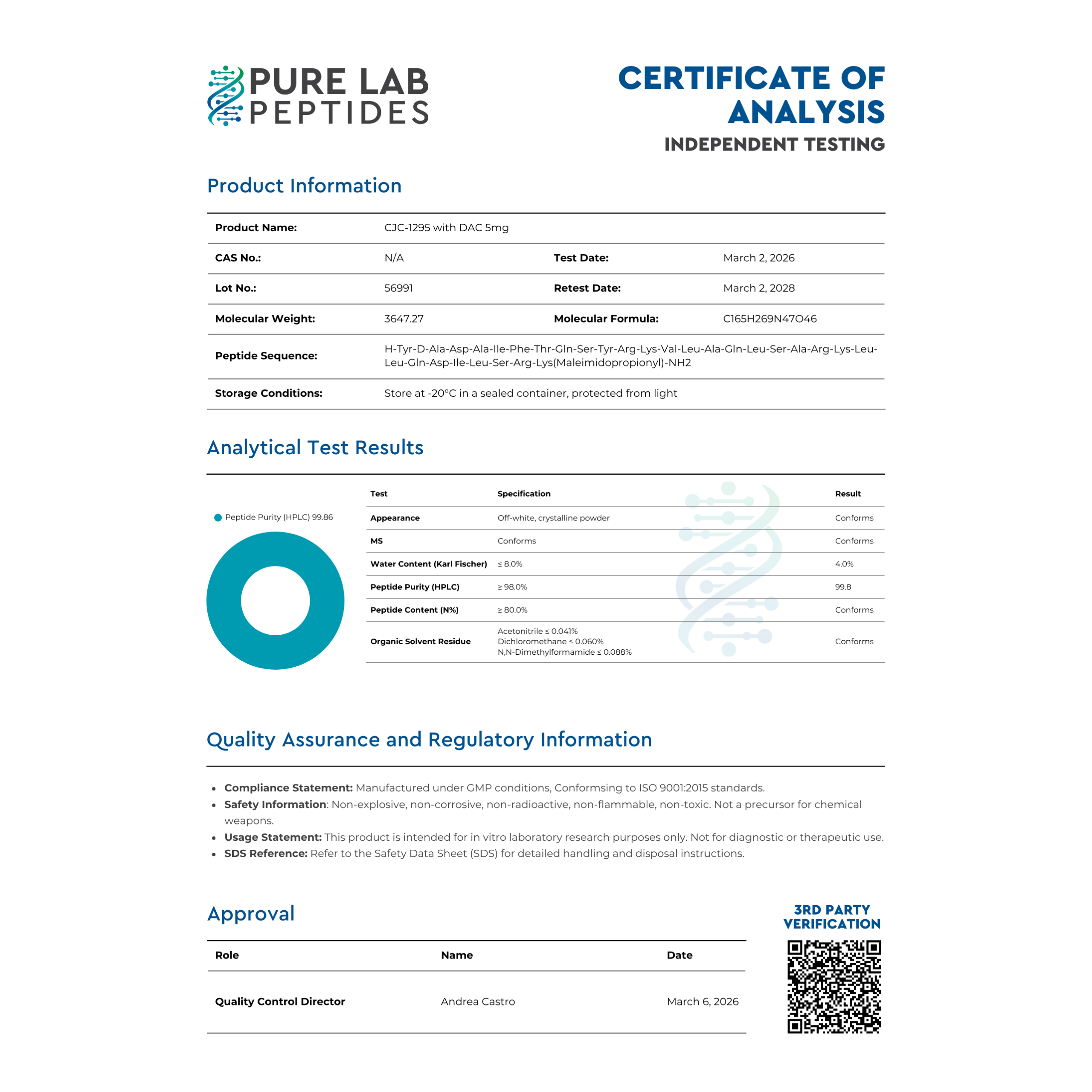
COA documentation matters because it is the record that links a specific lot to its reported testing data. For research buyers, a CJC-1295 DAC COA should clarify identity, purity, method, date, lot number, and testing source.
The COA should be reviewed alongside the label and product listing. Consistency across those materials is a core part of procurement quality.
A certificate of analysis should clarify what was tested, which lot was tested, what method was used, and what the reported result means. FDA analytical guidance discusses documentation of identity, quality, purity, and related analytical procedure information in regulated analytical contexts [14].
For RUO procurement, those principles translate into a practical documentation check. The COA should be specific enough to support laboratory recordkeeping.
A batch-specific COA should match the product name and lot number shown on the product listing or label. A generic COA is less useful because it may not show whether the document applies to the exact lot being reviewed.
For CJC-1295 DAC peptide procurement, batch specificity is one of the easiest quality signals to check. It is also one of the most important.
COA dates and lot numbers connect a document to a point in time and to a defined batch. Without those details, the document is harder to verify against supplier records.
This does not require complex interpretation. It requires careful matching.
Analytical testing review should ask what each method can and cannot support. HPLC is widely used in peptide analysis and purification, while LC-MS connects liquid chromatography with mass spectrometry for peptide identification and measurement workflows [11] [12].
For CJC-1295 DAC peptide documentation, HPLC and LC-MS should be read together when both are available. Purity and identity are related, but they are not the same documentation question.
HPLC separates compounds based on chromatographic behavior, making it useful for peptide analysis and purity-related review [11]. A COA may include an HPLC purity statement, chromatogram, or related method note.
Researchers should confirm whether the COA states the method clearly. The method name alone is useful, but supporting detail improves documentation value.
LC-MS supports identity review by combining chromatographic separation with mass spectrometry data. LC-MS-based peptide identification commonly relies on observed spectral measurements compared with theoretical or previously observed measurements [12].
For CJC-1295 DAC, LC-MS documentation can help support identity verification when it is batch-specific and aligned with the expected compound record. It should not be treated as a substitute for the entire documentation package.
Mass spectrometry signals can support identity evaluation through mass-related evidence and fragmentation patterns when appropriate. A CJC-1295 identification study in analytical literature used mass spectrometric interpretation to characterize a peptide sequence consistent with CJC-1295 [10].
For product-page review, the practical point is documentation quality. Mass data should connect to the lot being evaluated.
Lot traceability helps research buyers follow a material from listing to label to COA. It supports a basic question: do the supplier records describe the same research material?
Strong documentation standards do not rely on one isolated statement. They create consistency across every visible record.
Research buyers should compare the product name, lot number, COA date, testing method, purity statement, identity statement, and storage notes. If any of those elements conflict, the procurement team should request clarification before making a research purchasing decision.
This comparison is especially useful for compounds with naming variations. CJC-1295 DAC and DAC peptide terminology should be aligned across records.
RUO labeling should be consistent across the product page, label, COA, and supporting documents. FDA guidance on RUO/IUO labeling underscores that research-only labeling should be consistent with intended research positioning [17].
A page that mixes RUO language with consumer-facing claims creates confusion. A documentation-first page avoids that problem.
Storage documentation should be treated as part of the product record. ICH Q1A(R2) describes stability testing as a way to evaluate how quality varies with environmental factors such as temperature, humidity, and light [15].
For research peptides, storage notes should be recorded as supplier documentation, not improvised from general expectations. If the listing and COA mention storage information, those records should match.
Storage notes support research material review by creating a record of the supplier’s stated handling conditions. Peptide stability can be affected by intrinsic and external factors, including environmental conditions, as reviewed in peptide stability literature [16].
A product page should not overstate storage implications. It should tell research teams where to look: label, COA, product listing, and laboratory record.
The listing details should match the supplier documentation for compound name, lot number, material format, testing claims, and storage notes. If the page references purity or identity data, the COA should support that reference.
For CJC-1295 DAC research procurement, mismatch is the signal to pause. Documentation should clarify, not create extra interpretation work.
Common misunderstandings usually come from mixing literature, commercial search language, and product documentation. A safer CJC-1295 DAC research page keeps those areas distinct.
The goal is not to remove scientific context. The goal is to prevent scientific context from becoming unsupported product positioning.
Published literature can describe GHRH analog studies, receptor context, and analytical findings. Product positioning should describe RUO status, documentation, and test records.
A literature citation does not make a supplier product equivalent to a study material. It only supports the scientific context being discussed.
Commercial phrases can drift into claims when they start answering consumer questions instead of procurement questions. The safer version of commercial intent is documentation intent: what should a lab verify before selecting a research-use-only peptide?
That is why this page emphasizes COA review, analytical testing, and lot traceability. Those topics serve commercial research intent without crossing RUO boundaries.
Researchers comparing options to buy CJC-1295 DAC for research should use a structured procurement checklist. The checklist should confirm that the product listing, COA, label, and supplier documentation all point to the same research material.
A practical workflow can stay documentation-focused:
Labs should compare documentation, not marketing language. The most useful review points are identity record, purity method, COA specificity, lot traceability, RUO labeling, storage notes, and supplier clarity.
A quality-focused procurement review also checks what the page avoids. It should avoid personal-use framing and unsupported claims.
Use this checklist before selecting any RUO CJC-1295 DAC peptide material:
Pure Lab Peptides supplies compounds for laboratory research use only. Products are not intended for human or animal consumption, diagnostic use, therapeutic use, clinical use, veterinary use, or as food, drugs, cosmetics, dietary supplements, or household products. Researchers are responsible for ensuring lawful, appropriate handling and use in accordance with applicable regulations and institutional guidelines.
Review the product-page documentation, COA details, and RUO labeling before evaluating this compound for laboratory research.
Researchers evaluating where to buy CJC-1295 DAC for research should begin with compound identity, batch-specific documentation, and RUO labeling rather than consumer-facing claims. CJC-1295 is listed in PubChem as a chemical compound record under CID 91971820, with a molecular formula of C165H269N47O46, giving research teams a database point of comparison for identity documentation [1]. This Pure Lab Peptides guide explains how to review CJC-1295 DAC peptide documentation, published literature, analytical testing, and procurement records in a research-use-only context.
Researchers looking to buy CJC-1295 DAC for research should first review RUO labeling, the batch-specific COA, peptide identity data, purity testing, lot traceability, and supplier documentation. Products discussed in this article are intended for laboratory research use only and are not intended for human or animal consumption. Published CJC-1295 literature should be treated as research context, not product-positioning language.
The first review layer is the product documentation set: compound name, RUO label, lot number, COA, testing method, and storage record. For CJC-1295 DAC research, the documentation should make it easy to connect the product listing to the certificate of analysis and the batch-specific analytical record.
A documentation-first review also reduces ambiguity around similar names. CJC-1295 DAC, CJC-1295 with DAC, and DAC peptide language can appear in research discussions, so the procurement record should identify the exact material being evaluated.
Commercial search intent does not need to become consumer intent. A safer product-page approach is to frame buy-intent as technical procurement: what evidence helps a laboratory buyer evaluate a research material before selection?
That means the page should answer documentation questions. It should not answer personal-use, wellness, fitness, cosmetic, or product-performance questions.
A buy CJC-1295 DAC for research page should prioritize COA review because the COA is the central document connecting a product listing to analytical claims. ICH Q2(R2) explains that analytical procedure validation concerns whether an analytical procedure is fit for its intended purpose, including common measurements such as identity, purity, and quantitative or qualitative measurements [13].
For research procurement, that means the COA should not be treated as decoration. It should be checked against the lot number, product name, testing method, date, and supplier record.
CJC-1295 DAC is discussed in scientific literature as a long-acting GHRH analog connected to growth hormone-releasing factor research [2]. The DAC element is commonly described in the literature as drug affinity complex chemistry, with albumin association used to change the research compound’s persistence profile in study settings [2] [3].
This article does not position the compound for personal or clinical application. It treats CJC-1295 DAC as a research peptide requiring careful documentation review.
The canonical target for this page is CJC-1295 DAC. PubChem provides a chemical record for CJC-1295 that can support identity cross-checking alongside supplier documentation and batch-specific analytical data [1].
Classification matters because CJC-1295 DAC belongs in GHRH analog research, not general wellness language. The literature on GHRH and the GHRH receptor gives the compound’s pathway context, while the product page should remain focused on RUO documentation [6].
The DAC peptide concept is relevant because published CJC-1295 research describes albumin bioconjugate design and long-lasting GRF analog characterization [2]. In product-page copy, that concept should be presented as literature context and identity background.
Researchers should not treat DAC language as a product claim. It is a signal to verify compound identity, labeling, and analytical documentation.
Batch-specific documentation helps confirm that the material being reviewed matches the lot described in the COA. A batch record should connect the CJC-1295 DAC peptide name, lot number, purity statement, identity method, and testing date.
This is where a product page can add practical value. The page should help research buyers understand which documents to request, compare, and retain in laboratory records.
A CJC-1295 research peptide page should present the compound as an RUO laboratory material. The page can describe published literature, GHRH analog context, and analytical documentation, but it should not convert study observations into product claims.
The best product-page positioning is plain and technical. It gives research buyers enough information to evaluate documentation without implying consumer application.
A clear research material listing identifies the compound, research-only status, available documentation, and batch-specific testing record. It should also keep supplier language aligned with the COA and label.
A useful listing avoids vague claims. It directs attention to analytical testing, identity review, purity documentation, and lot traceability.
RUO labeling should be clear, visible, and consistent across the product page, label, and supporting documents. FDA RUO/IUO guidance for IVD products emphasizes that RUO labeling must align with intended research positioning, which supports the broader editorial principle that labels and copy should tell the same story [17].
For peptide product pages, clear RUO language helps prevent drift into clinical-use language. It also helps procurement teams distinguish documentation review from product-use messaging.
Catalog language should describe the research material and its documentation, not imply a research finding or product outcome. A product amount, listing format, or package description is a catalog specification, not a claim about study design or application.
The safer editorial rule is simple. If a statement cannot be tied to identity, documentation, analytical testing, or published literature boundaries, it likely does not belong on an RUO product page.
GHRH research centers on growth hormone-releasing hormone, its receptor, and pituitary pathway biology. Reviews on GHRH and its receptor describe the molecular framework for understanding pituitary somatotroph signaling and GHRH receptor biology [6] [7].
CJC-1295 DAC research fits into that same lane because published studies evaluate the compound as a long-acting GHRH analog. That literature should be presented as academic context only.
Growth hormone-releasing factor, also called GHRH in much of the literature, provides the biological reference point for CJC-1295 DAC. Jetté and colleagues described hGRF(1-29)-albumin bioconjugates and identified CJC-1295 as a long-lasting GRF analog in a peer-reviewed study [2].
For product-page readers, the key takeaway is not product action. It is that CJC-1295 DAC documentation should be reviewed in the context of GHRH analog identity and pathway literature.
NCBI Gene describes GHRHR as encoding a receptor for growth hormone-releasing hormone, with receptor binding connected to pituitary signaling biology [4]. UniProt similarly describes the reviewed human GHRHR entry as a GRF receptor coupled to G proteins and adenylyl cyclase signaling [5].
That pathway context helps define the research lane. It does not establish an RUO product application.

CJC-1295 DAC research fits endocrine pathway models through GHRH analog and receptor-pathway literature. The compound’s scientific background is tied to GHRH receptor signaling, albumin-associated peptide design, and model-specific GH/IGF-1 axis observations in published studies [2] [9].
A research product page should separate those study categories from product positioning. The article can explain why the literature matters without implying an applied use.
GHRHR is generally described as a G protein-coupled receptor associated with adenylyl cyclase signaling in authoritative protein and gene databases [4] [5]. That receptor context belongs in the research background section.
It should not become a claim about a supplied research material. Product-page language should stay with documentation, identity, and literature interpretation.
A pathway connection tells researchers where the compound appears in the literature. It does not prove that a product listing has any effect beyond its documented identity and testing record.
This distinction matters for RUO pages. Scientific background can support topical completeness, while COA and analytical testing support procurement review.
CJC-1295 has appeared in model-specific literature, including GHRH knockout mouse research and studies outside RUO product use [8] [3]. Those studies are part of the evidence landscape, not instructions or claims for RUO materials.
The safer reading is model-first. Identify the model, the measured endpoint, the limitation, and the boundary before interpreting the study.
Published CJC-1295 DAC research includes compound characterization, pharmacokinetic literature, preclinical model work, and proteomic observations [2] [3] [8] [9]. Product pages should cite that literature carefully and avoid overstating what it means.
The strongest editorial approach is to present literature as context. Supplier documentation still needs its own review.
A strong source filter gives priority to peer-reviewed literature, official databases, and analytical chemistry references. Vendor pages, forums, and wellness content should not be used as scientific evidence for a CJC-1295 DAC research page.
For this article, compound identity, receptor context, and analytical testing are supported by PubChem, NCBI, UniProt, PubMed-indexed research, ICH, and FDA resources [1] [4] [13].
The most useful literature signals are compound identity, analog class, receptor pathway context, model type, analytical method, and stated limitations. For CJC-1295 DAC, literature on albumin bioconjugates and long-acting GHRH analogs is directly relevant to identity context [2].
Procurement teams should pair those signals with supplier-specific documents. Literature can inform the review, but it cannot replace batch-specific testing.
Evidence interpretation should separate source type, model type, and RUO relevance. The table below gives a safe framework for product-page readers.
| Research Area | What Literature Examines | Evidence Type | RUO Interpretation |
|---|---|---|---|
| Compound identity | CJC-1295 chemical record and database identifiers [1] | Official database | Supports identity cross-checking, not product claims |
| GHRH analog design | Albumin bioconjugate and long-lasting GRF analog characterization [2] | Peer-reviewed study | Provides scientific background for DAC peptide context |
| Receptor pathway | GHRHR gene and receptor signaling context [4] [5] | Official database | Supports pathway classification only |
| Analytical testing | HPLC peptide analysis and LC-MS peptide identification principles [11] [12] | Analytical literature | Supports documentation review workflow |
| RUO labeling | FDA RUO/IUO guidance for research labeling context [17] | Official guidance | Supports clear separation from non-research positioning |
Mechanistic findings describe what researchers observed in a defined model. Product-page claims describe what a product is being positioned to do.
Those two categories must stay separate. A CJC-1295 DAC product page can discuss GHRH analog literature while still grounding its commercial value in documentation quality.
Lab teams can separate study context from supplier copy by asking whether a statement belongs to a published paper, a database record, a COA, or the product listing. If the statement is a study observation, it should stay attached to the study context.
If the statement is a supplier claim, it should be supported by batch-level documentation. For analytical statements, ICH Q2(R2) and FDA method-validation guidance provide useful quality concepts for assessing whether methods are fit for purpose [13] [14].
Controlled language uses terms such as “examined,” “characterized,” “reported,” and “observed.” It avoids turning a model-specific finding into a product promise.
For CJC-1295 DAC research, controlled language is especially important because the compound sits in an endocrine pathway category. Product copy should keep the focus on identity, COA review, and RUO labeling.

Research literature can describe compound class, pathway context, model findings, and analytical methods. Product pages should describe research material documentation, not applied outcomes.
Some published literature outside the scope of RUO product use has examined this compound class in human study settings. That literature should not be interpreted as a use claim for research-use-only materials [3].
Study findings depend on study design, model type, methods, and limitations. Product claims are supplier statements about a research material.
A safe product-page article should not collapse those categories. It should cite the literature, state the boundary, and return to documentation review.
Claim boundaries mean the page avoids consumer-facing interpretations and does not frame CJC-1295 DAC as a wellness, fitness, cosmetic, or clinical material. Phrases related to product performance require careful framing because they can become product claims when separated from model-specific literature context.
Search phrases such as “CJC-1295 DAC for sale” can also pull copy toward retail language. RUO positioning reframes that intent toward COA review, analytical testing, lot traceability, and supplier documentation.
COA documentation matters because it is the record that links a specific lot to its reported testing data. For research buyers, a CJC-1295 DAC COA should clarify identity, purity, method, date, lot number, and testing source.
The COA should be reviewed alongside the label and product listing. Consistency across those materials is a core part of procurement quality.
A certificate of analysis should clarify what was tested, which lot was tested, what method was used, and what the reported result means. FDA analytical guidance discusses documentation of identity, quality, purity, and related analytical procedure information in regulated analytical contexts [14].
For RUO procurement, those principles translate into a practical documentation check. The COA should be specific enough to support laboratory recordkeeping.
A batch-specific COA should match the product name and lot number shown on the product listing or label. A generic COA is less useful because it may not show whether the document applies to the exact lot being reviewed.
For CJC-1295 DAC peptide procurement, batch specificity is one of the easiest quality signals to check. It is also one of the most important.
COA dates and lot numbers connect a document to a point in time and to a defined batch. Without those details, the document is harder to verify against supplier records.
This does not require complex interpretation. It requires careful matching.

Analytical testing review should ask what each method can and cannot support. HPLC is widely used in peptide analysis and purification, while LC-MS connects liquid chromatography with mass spectrometry for peptide identification and measurement workflows [11] [12].
For CJC-1295 DAC peptide documentation, HPLC and LC-MS should be read together when both are available. Purity and identity are related, but they are not the same documentation question.
HPLC separates compounds based on chromatographic behavior, making it useful for peptide analysis and purity-related review [11]. A COA may include an HPLC purity statement, chromatogram, or related method note.
Researchers should confirm whether the COA states the method clearly. The method name alone is useful, but supporting detail improves documentation value.
LC-MS supports identity review by combining chromatographic separation with mass spectrometry data. LC-MS-based peptide identification commonly relies on observed spectral measurements compared with theoretical or previously observed measurements [12].
For CJC-1295 DAC, LC-MS documentation can help support identity verification when it is batch-specific and aligned with the expected compound record. It should not be treated as a substitute for the entire documentation package.
Mass spectrometry signals can support identity evaluation through mass-related evidence and fragmentation patterns when appropriate. A CJC-1295 identification study in analytical literature used mass spectrometric interpretation to characterize a peptide sequence consistent with CJC-1295 [10].
For product-page review, the practical point is documentation quality. Mass data should connect to the lot being evaluated.
Lot traceability helps research buyers follow a material from listing to label to COA. It supports a basic question: do the supplier records describe the same research material?
Strong documentation standards do not rely on one isolated statement. They create consistency across every visible record.
Research buyers should compare the product name, lot number, COA date, testing method, purity statement, identity statement, and storage notes. If any of those elements conflict, the procurement team should request clarification before making a research purchasing decision.
This comparison is especially useful for compounds with naming variations. CJC-1295 DAC and DAC peptide terminology should be aligned across records.
RUO labeling should be consistent across the product page, label, COA, and supporting documents. FDA guidance on RUO/IUO labeling underscores that research-only labeling should be consistent with intended research positioning [17].
A page that mixes RUO language with consumer-facing claims creates confusion. A documentation-first page avoids that problem.
Storage documentation should be treated as part of the product record. ICH Q1A(R2) describes stability testing as a way to evaluate how quality varies with environmental factors such as temperature, humidity, and light [15].
For research peptides, storage notes should be recorded as supplier documentation, not improvised from general expectations. If the listing and COA mention storage information, those records should match.
Storage notes support research material review by creating a record of the supplier’s stated handling conditions. Peptide stability can be affected by intrinsic and external factors, including environmental conditions, as reviewed in peptide stability literature [16].
A product page should not overstate storage implications. It should tell research teams where to look: label, COA, product listing, and laboratory record.
The listing details should match the supplier documentation for compound name, lot number, material format, testing claims, and storage notes. If the page references purity or identity data, the COA should support that reference.
For CJC-1295 DAC research procurement, mismatch is the signal to pause. Documentation should clarify, not create extra interpretation work.
Common misunderstandings usually come from mixing literature, commercial search language, and product documentation. A safer CJC-1295 DAC research page keeps those areas distinct.
The goal is not to remove scientific context. The goal is to prevent scientific context from becoming unsupported product positioning.
Published literature can describe GHRH analog studies, receptor context, and analytical findings. Product positioning should describe RUO status, documentation, and test records.
A literature citation does not make a supplier product equivalent to a study material. It only supports the scientific context being discussed.
Commercial phrases can drift into claims when they start answering consumer questions instead of procurement questions. The safer version of commercial intent is documentation intent: what should a lab verify before selecting a research-use-only peptide?
That is why this page emphasizes COA review, analytical testing, and lot traceability. Those topics serve commercial research intent without crossing RUO boundaries.

Researchers comparing options to buy CJC-1295 DAC for research should use a structured procurement checklist. The checklist should confirm that the product listing, COA, label, and supplier documentation all point to the same research material.
A practical workflow can stay documentation-focused:
Labs should compare documentation, not marketing language. The most useful review points are identity record, purity method, COA specificity, lot traceability, RUO labeling, storage notes, and supplier clarity.
A quality-focused procurement review also checks what the page avoids. It should avoid personal-use framing and unsupported claims.
Use this checklist before selecting any RUO CJC-1295 DAC peptide material:
Pure Lab Peptides supplies compounds for laboratory research use only. Products are not intended for human or animal consumption, diagnostic use, therapeutic use, clinical use, veterinary use, or as food, drugs, cosmetics, dietary supplements, or household products. Researchers are responsible for ensuring lawful, appropriate handling and use in accordance with applicable regulations and institutional guidelines.
Review the product-page documentation, COA details, and RUO labeling before evaluating this compound for laboratory research.
Research use only means CJC-1295 DAC is intended solely for laboratory research contexts. In a product-page setting, RUO framing keeps attention on compound identity, product documentation, COA review, analytical testing, and lot traceability. It does not position the material for human, animal, personal, wellness, or clinical purposes.
Researchers should consider documentation quality before they buy CJC-1295 DAC for research. Key review points include the batch-specific COA, lot number, product label, supplier documentation, and whether analytical testing supports peptide identity and purity. A documentation-first review helps keep commercial research intent separate from product-claim language.
Albumin binding relates to peptide half-life as a literature concept connected to the DAC design discussed in CJC-1295 research. Published studies describe CJC-1295 as a long-lasting GRF analog, but that information should remain scientific context rather than product positioning [2]. Researchers should connect this concept to identity documentation, not applied claims.
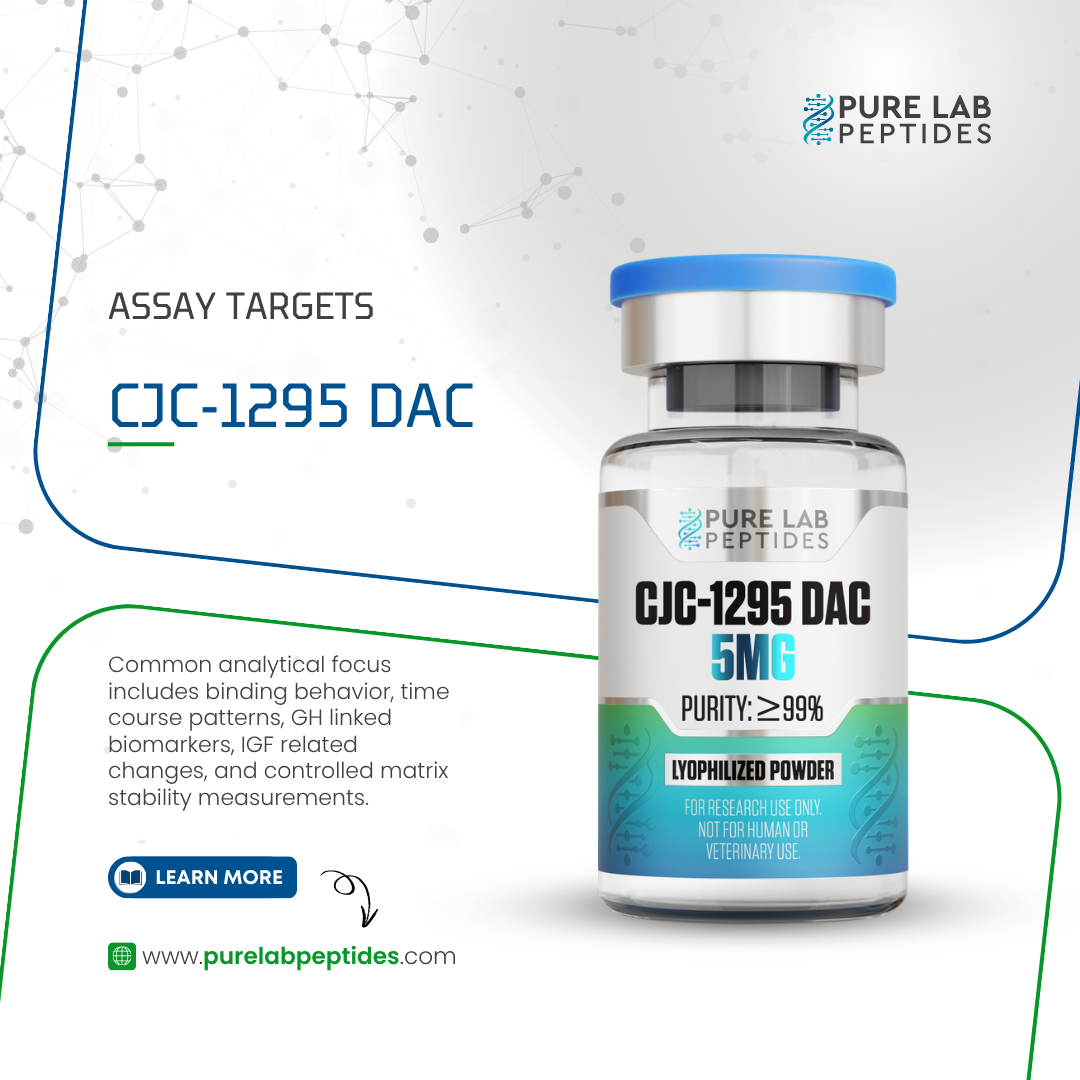
Molecular identity details can support CJC-1295 DAC documentation review by giving researchers comparison points for the product record. These may include molecular weight, molecular formula, peptide sequence when verified, and naming consistency across the COA and supplier documentation. PubChem provides a compound record for CJC-1295 that can support identity cross-checking [1].
Published literature about CJC-1295 DAC should be interpreted as research context, not product-page proof. Literature may discuss GHRH analog research, receptor pathway models, plasma measurements, or in vitro laboratory research, but each finding depends on its model and methods. The safer review approach separates study context from RUO product documentation.
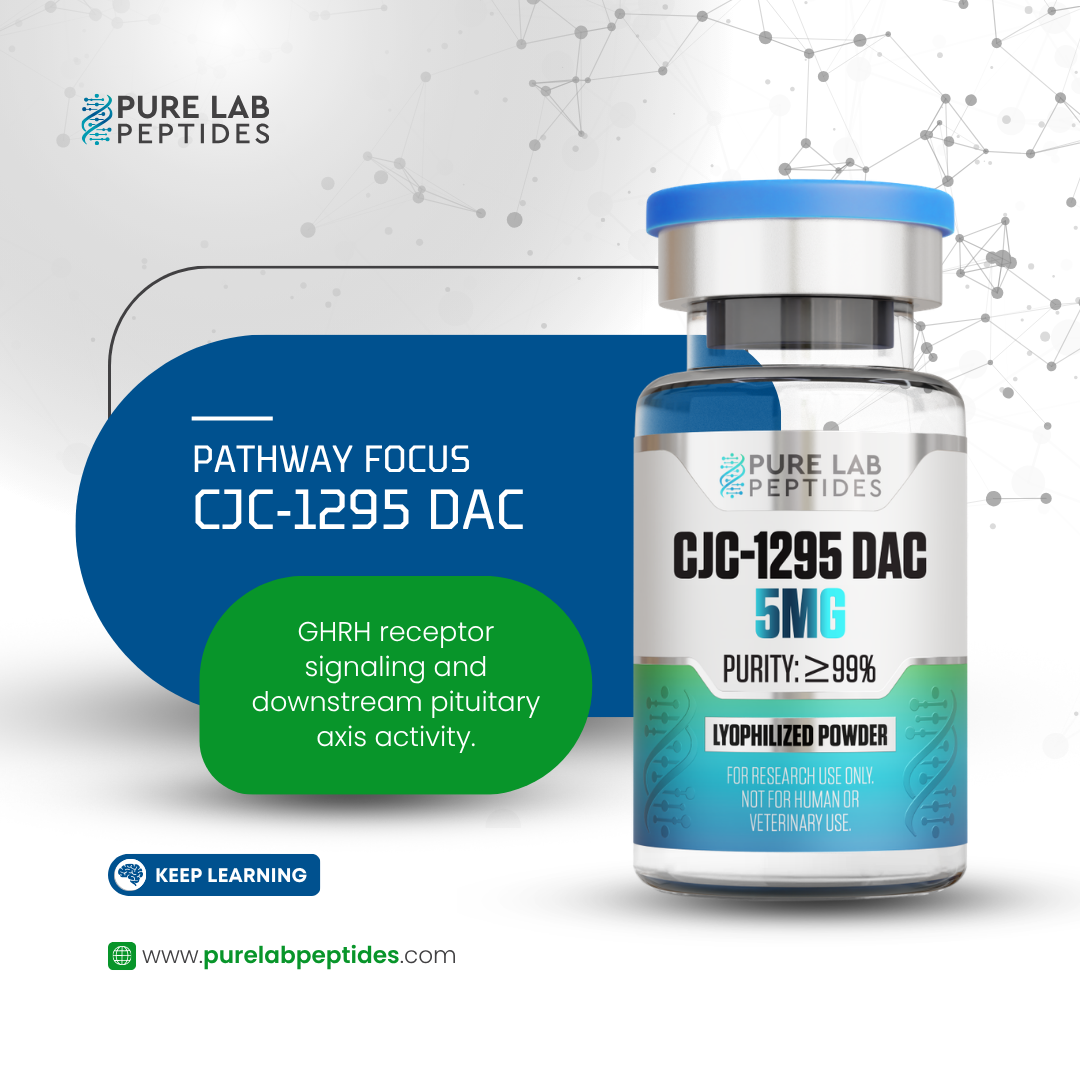
Cell signaling context helps place CJC-1295 DAC within GHRH receptor pathway research. Authoritative databases describe GHRHR in relation to G protein signaling and cyclic adenosine monophosphate pathway context [4] [5]. On an RUO page, that pathway information supports research classification only and should stay separate from product claims.
The following authors are recognized for published research that helped shape the scientific context discussed in this article.
Author profile: ASCI Directory
Lawrence A. Frohman is recognized for published work on GHRH analog research, pituitary pathway biology, and CJC-1295 literature cited in this article. His publications help frame how CJC-1295 DAC can be discussed as a research compound within the GH Secretagogue and GHRH Research lane. The work selected here is relevant to literature interpretation because it connects CJC-1295 with endocrine pathway models, serum protein profile research, and model-specific scientific context. For an RUO product page, that background supports careful separation between published findings, compound characterization, and supplier documentation. It also gives procurement-focused readers a stronger basis for asking documentation-centered questions.
Selected publications:
Author profile: Johns Hopkins University Profile
Roberto Salvatori is recognized for published work relevant to GHRH pathway models and the preclinical background referenced in the CJC-1295 DAC article. His publications help explain why GHRH knockout model literature can provide pathway context while remaining separate from RUO product positioning. The selected work is useful for readers comparing published literature with laboratory documentation because it focuses on model design, receptor pathway context, and CJC-1295-related research interpretation. In a product-page setting, these publications support a documentation-first review of peptide identity, analytical records, and lot-level consistency rather than consumer-facing claims.
Selected publications:
This research disclaimer clarifies how this page handles published literature and search language around CJC-1295 DAC. In GH Secretagogue and GHRH Research content, terms such as 5mg, body composition, growth hormone levels, growth hormone production, release of growth hormone, IGF-1 levels, repeated exposure to CJC-1295 DAC, healthy adults, human growth, peptide therapy, and clinical outcomes can drift into consumer-facing, administration-focused language, wellness language, therapeutic language, or product-claim language when framed incorrectly. These phrases are included only as examples of boundary-sensitive terminology that requires careful separation from RUO product positioning.
For this page, boundary-sensitive phrasing is handled as research-language context, not product uses, outcomes, instructions, or recommendations. The focus remains on CJC-1295 DAC identity, COA review, analytical testing, peptide purity, lot traceability, research-use-only labeling, product documentation, and published literature boundaries. Model-specific research interpretation should stay connected to its source context and should not be converted into consumer outcomes, product effects, efficacy statements, or performance product language.
Discount Applied Successfully!
Your savings have been added to the cart.




There are no reviews yet.